
In this lesson, students examine why we enforce some laws and not others. We illustrate this question using the historical example of lynching. The lesson asks students to explore why lynching was almost never punished, despite the fact that murder was illegal.
Trigger Warning: The lesson contains sensitive images and descriptions of racial violence in the form of lynching. Scaffold the material to ensure that it is age appropriate.
Essential Questions
Why do we enforce/follow some laws and not others?
Why do the law and societal practices sometimes differ?
How can societal practices break the law?
Background Knowledge
Following the end of the Civil War and the ratification of the Thirteenth Amendment, various strategies were put in place to control and intimidate the formerly enslaved. Among them violence and particularly mob violence targeted African Americans, especially, although not exclusively, in the South. Equal Justice Initiative, an organization that documents lynching in the United States, has documented 4,084 racial terror lynchings in twelve Southern states between the end of the Reconstruction in 1877 and 1950. The National Association for the Advancement of Colored People (NAACP), which began compiling lynching statistics in 1912, reports that from 1882 to 1968, 4,743 lynchings occurred in the US. These numbers are likely underreported. Although the federal anti-lynching law did not pass until 2022, some states had anti-lynching laws during the Jim Crow era. For example, Virginia was the first state to define lynching as a state crime in 1928. In all states murder was illegal.
History of Lynching in America, NAACP:
https://naacp.org/find-resources/history-explained/history-lynching-america
Equal Justice Initiative report:
https://lynchinginamerica.eji.org/report/
Anti-Lynching Law of 1928, Encyclopedia of Virginia,:
https://encyclopediavirginia.org/entries/anti-lynching-law-of-1928/
Lynching in Arkansas history, Encyclopedia of Arkansas:
https://encyclopediaofarkansas.net/entries/lynching-346
Guy Lancaster, “The History of Lynching in Arkansas and its Troubling Modern Day Parallels,” Arkansas Times (Nov. 29, 2021):
https://arktimes.com/arkansas-blog/2021/11/29/the-history-of-lynching-in-arkansas-and-its-troubling-modern-day-parallels
Learning Objectives
By the end of this lesson, students will:
- Define differences between de facto and de jure.
- Explain why lynching was often not prosecuted.
Key Terms
De facto – Latin for “in fact,” existing in fact; a legal concept used to refer to what happens in reality or in practice, regardless of laws.
De jure – Latin for “by law,” officially; refers to what happens according to official laws.
Jim Crow – A set of laws and practices that regulated racial segregation and discrimination against African Americans, dominant across Southern and border states between 1877 and the mid-1960s.
Lynching – The public killing of an individual without a legal trial, often by mob.
Segregation – A policy or practice of keeping different groups separate from each other, typically based on race or gender.
Primary Sources
Sources included in this lesson focus on a relationship between lynching and law. Encourage students to reflect on how the supporters of lynching justified the crime and how anti-lynching activists argued their position.
Click here to access De Facto vs. De Jure: Lynching – Primary Sources.
Procedures
1) Starter (bell ringer)
De facto/de jure today: Ask students if they have ever seen or heard of people violating laws and not being punished. After collecting examples on the board, encourage students to discuss why we – as a society – accept breaking some laws or rules. You may also present possible situations/scenarios to students [photos or list]. Ask students whether they know these actions are illegal and/or break important rules.
Possible examples:
1. Speeding
2. Texting and driving
3. Downloading music or movies illegally
4. Littering
5. Accessing textbooks and other books via illegal resources
6. Sharing passwords for streaming services
7. Using AI to complete your school assignments (cheating = breaking school rules)
2) Guiding questions
What is the difference between de facto and de jure?
Why was lynching not prosecuted?
3) Background information
The “de jure” article from the Encyclopedia Britannica provides a helpful overview of the de facto vs. de jure distinction, including examples from American history: https://www.britannica.com/topic/de-jure.
This excerpt from Manfred Berg’s Popular Justice: A History of Lynching in America (Bloomsbury Publishing, 2011) provides a brief overview of why the repeated efforts to introduce federal anti-lynching bills failed in the early 1900s. Teachers might assign this secondary source to students or use it to contextualize the primary sources. Click here to access an excerpt from Berg’s Popular Justice.
“Lynching in America” by PBS American Experience: https://www.pbs.org/wgbh/americanexperience/features/emmett-lynching-america/.
Thought bubbles:
– Laws are not always enforced.
– Society often enforces unspoken rules and norms that may be illegal.
– Violence was used to intimidate and control African Americans.
– Mob violence (lynching) was not punished by law enforcement.
– Jim Crow was the period after the Reconstruction when the rights of African Americans and other minority groups were violated.
– Despite the constitutional protection of the equality of all before the law, many groups were discriminated against.
4) Activities
Analysis of provided primary sources. We encourage the teachers to select the sources from the provided set that will best meet their classroom goals.
Complete the activities section with the analysis of Billie Holiday’s rendition of “Strange Fruit” (1939).
Click here to access the song on YouTube.
Click here to access the lyrics.
5) Rubric
[1 – 5] Exceeding/proficient/novice/emerging/unsatisfactory
Were you engaged and actively participating?
Can you articulate the understanding of key concepts?
Can you accurately identify examples of each concept?
Can you apply the de jure and de facto concepts to historical examples and today’s world?
Assessment
Suggested activities:
What did you know? What do you want to know? What did you learn? – Write on a piece of paper. [KWL]
Exit ticket: Define in your own words de facto and de jure?
Exit ticket: Why do we enforce/follow some laws and not others? Use examples from today’s class to support your answer.
Exit ticket: Provide an example of de facto/de jure today.
Reflection
Can you see examples of de facto vs. de jure today?
How do you see people responding to violence today?
What can we do to prevent violence in our society today?
Extension Relevance
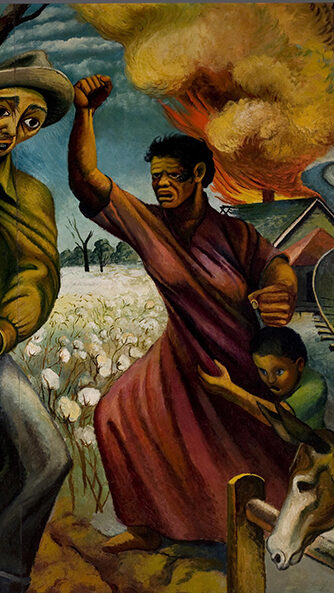
If you can, visit UA Little Rock Downtown to examine the Joe Jones mural “The Struggle in the South” (1935). Journal what you feel when you’re looking at the mural. What do you feel, see, think?
Explore the National Memorial for Peace and Justice in Montgomery, Alabama (virtually or, if possible, take a trip): https://legacysites.eji.org/about/memorial/. How would you memorialize the victims of lynching in your town or state?
Research a historical case of lynching in your state using the Chronicling America database by the Library of Congress. How did the newspapers cover the case you selected? Do you see the newspapers defending or opposing lynching?
Arkansas Social Studies Standards
| African American History | Era 6: 1870-1900, Hardening of Jim Crow – the African American experience in the post-Reconstruction Era (1877-1920) | H.4.AAH.5 |
| US History | Era 7: 1890-1930, Emergence of Modern America | H.5.8.7 |
| Arkansas History | Era 7: Perspectives of Arkansans in the early 20th century (1901-1930) | H.5.ARH.2 |