
In this lesson, students examine why we enforce some laws and not others. The historical example of voting rights illustrates the de facto vs. de jure issue. The lesson asks students to explore why some groups of voters were excluded from voting after landmark laws ensuring their voting rights were passed.
Essential Questions
Why do we enforce/follow some laws and not others?
Why do the law and societal practices sometimes differ?
How can societal practices break the law?
Background Knowledge
Following the ratification of the Fifteenth Amendment (1870), which banned voting discrimination and exclusion on account of race, voting rights gradually expanded to cover groups previously excluded from the voting process. The Fifteenth Amendment granted voting rights to African American men. In 1920, the Nineteenth Amendment banned voting discrimination and exclusion on account of sex, which granted voting rights to women. In 1924, Congress passed the Indian Citizenship Act and ensured voting rights for the Native Americans who had not been citizens prior to 1924 (around 60 percent of Native Americans were US citizens before 1924). In 1952, the federal law that barred immigrants of Asian descent from becoming US citizens, and thus from being able to vote, was replaced by the McCarran-Walter Act. The McCarran-Walter Act eliminated the “alien ineligible to citizenship” category from US immigration law, which meant that all immigrants had to meet the same requirements to be eligible for citizenship, regardless of their place of origin. Despite these federal laws, for decades, states enacted a variety of policies and practices to exclude certain groups from voting. In the first half of the 20th century, it was still mostly white Americans who voted without major restrictions, although especially poor and uneducated white voters were often excluded from voting, especially in the South. The Voting Rights Act of 1965 was designed to delegalize all those exclusionary practices and address problems emerging from the patchwork of different existing laws.
Introduction To Federal Voting Rights Laws, Department of Justice:
https://www.justice.gov/crt/introduction-federal-voting-rights-laws-1
“A Right Deferred: African American Voter Suppression after Reconstruction” by Marsha J. Tyson Darling (History Now, Issue 51, Summer 2018), The Gilder Lehrman Institute of American History: https://www.gilderlehrman.org/history-resources/essays/right-deferred-african-american-voter-suppression-after-reconstruction
Eleanor Clift, “Women’s Long Journey for the Vote,” The Gilder Lehrman Institute of American History: https://www.gilderlehrman.org/history-resources/essays/womens-long-journey-vote
Voting and Voting Rights from the Encyclopedia of Arkansas:
https://encyclopediaofarkansas.net/entries/voting-and-voting-rights-4916/
Learning Objectives
By the end of this lesson, students will:
- Define differences between de facto and de jure.
- Discuss strategies implemented to exclude various groups from voting.
Key Terms
De facto – Latin for “in fact,” existing in fact; a legal concept used to refer to what happens in reality or in practice, regardless of laws.
De jure – Latin for “by law,” officially; refers to what happens according to official laws.
Jim Crow – A set of laws and practices that regulated racial segregation and discrimination against African Americans, dominant across Southern and border states between 1877 and the mid-1960s.
Suffrage – The right to vote in public elections.
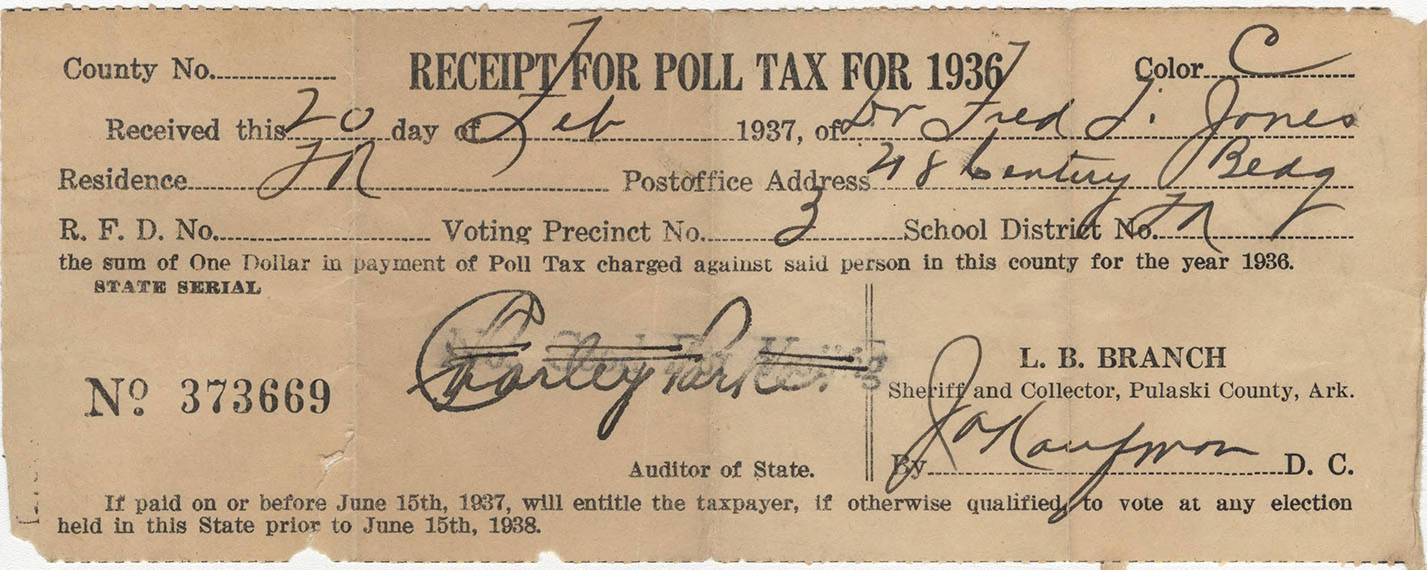
Poll tax – A tax or a fixed sum of money required as a condition to vote.
Literacy test – A reading comprehension test individuals had to take and pass in some states as a condition to vote.
Segregation – A policy or practice of keeping different groups separate from each other, typically based on race or gender.
Primary Sources
Click here to access De Facto vs. De Jure: Voting primary sources.
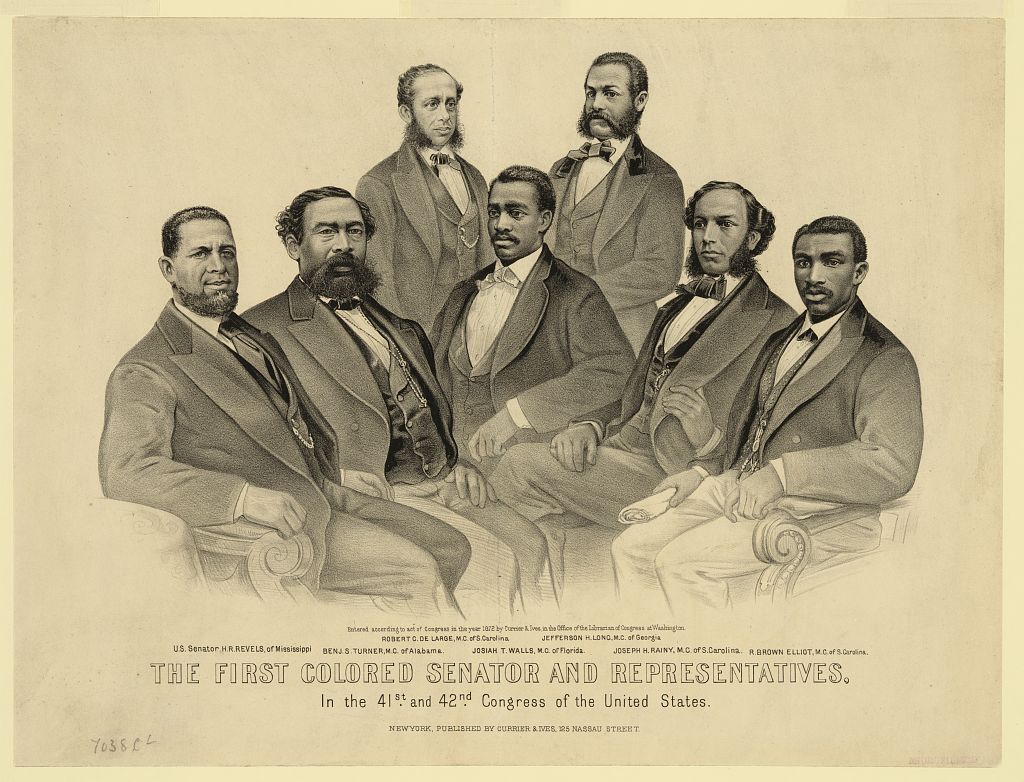
Image: “The first colored senator and representatives in the 41st and 42nd Congress of the United States,” 1872, Library of Congress. George Henry White of North Carolina was the last Black congressman from the South serving after the end of the Reconstruction. He was elected in 1896, reelected in 1898, and his term ended in 1901. Such strategies as poll taxes, literacy tests, limiting primaries to white voters only, or voters intimidation succeeded in suppressing the Black vote. No black person served in Congress until 1928, when Oscar De Priest of Illinois won as a Republican, becoming the first Black congressman elected in the 20th century. In 1972, Barbara Jordan of Texas and Andrew Young of Georgia were the first Black individuals elected to the House from the former Confederate states since White’s reelection in 1898. Between 1881 and 1967, no Black senator served in Congress.
Procedures
1) Starter
– Match key terms with definitions
– De facto/de jure today. Ask students if they have ever seen or heard of people violating laws and not being punished. Ask students to name some actions or practices that are illegal and/or break important rules but are rarely punished and that we may accept as individuals or society.
Possible examples:
– Texting and driving
– Speeding
– Littering
– Downloading music or movies illegally
– Accessing books via illegal resources
– Sharing accounts/passwords for streaming services
– Using AI to complete your school assignments (breaking school rules)
2) Guiding questions
What is the difference between de facto and de jure?
How and why were various groups excluded from voting?
3) Background information
The “de jure” article from the Encyclopedia Britannica provides a helpful overview of the de facto vs. de jure distinction, including examples from American history: https://www.britannica.com/topic/de-jure.
4) Activities
Primary source analysis. We encourage teachers to select the sources from the provided set that will best meet their classroom goals.
Students complete the 1965 Alabama literacy test. Click here to access a PDF file from Jim Crow Museum.
Click here to access an article by Franklin Hughes of Jim Crow Museum explaining the source of the literacy test used by the museum.
5) Rubric
[1 – 5] Exceeding/proficient/novice/emerging/unsatisfactory
Were you engaged and actively participating?
Can you articulate the understanding of key concepts?
Can you accurately identify examples of each concept?
Can you apply the de jure and de facto concepts to historical examples and today’s world?
Assessment
Suggested activities:
What did you know? What do you want to know? What did you learn? – Write on a piece of paper. [KWL]
Exit ticket: Define in your own words de facto and de jure.
Exit ticket: Why do we enforce/follow some laws and not others? Use examples from today’s class to support your answer.
Exit ticket: Provide an example of de facto/de jure today.
Reflection
How does de facto vs. de jure appear in our lives today?
Have you heard stories from people who were excluded from voting? How did that affect their lives?
Why do we need to vote? Why is it important to vote?
Do your adult family members vote? Do you want to vote?
Extension Relevance
Interview someone you know who lived through segregation and experienced or witnessed voting suppression or exclusion.
Is there anything that makes voting difficult or even impossible today? Conduct online research and present your findings on a poster.
What does a person need to do to make sure they are eligible to vote in your state? Conduct online research and present your findings on a poster.
Arkansas Social Studies Standards
| African American History | Era 9: 1945 to Early 1970s, Illusion of Equality – African American experience (1950-1970) | H.5.AAH.4 H.5.AAH.6 |
| Civics – Voting Rights | C.3.CIV.1 C.3.CIV.8 C.3.CIV.10 C.4.CIV.5 | |
| US Government – Voting Rights | C.4.USG.4 | |
| US History | Era 9: 1945 to Early 1970s, Post-war United States through 1970s – International events and trends resulting in the emergence of the United States as a superpower | H.5.USH.17 H.5.USH.18 H.5.USH.20 H.5.USH.21 |