
1923-1924
Commonwealth College
In 1923, Kate Richards O’Hare and William Zeuch established Commonwealth College at the Newllano Cooperative Colony near Leesville, Louisiana. O’Hare and Zeuch shared commitment to labor movement and supporting industrial workers. While they both identified as socialists, O’Hare was an ardent political activist and Zeuch an academic interested in theoretical labor education. Zeuch’s approach shaped the college in its early years. As Commonwealth’s first director, he envisioned a “non-sectarian” residential program training modern labor leaders, i.e. with no ties to any single ideology or party.
In 1924, interpersonal conflicts forced O’Hare, Zeuch, and their supporters to leave Louisiana. Following short-lived efforts to settle in Ink, Arkansas, the Commoners, as the staff, faculty, and students were known, found their home near Mena, Arkansas.
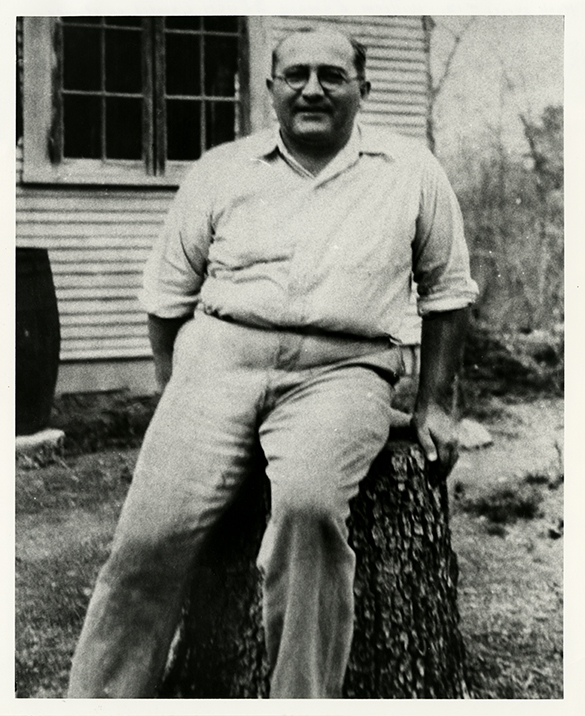
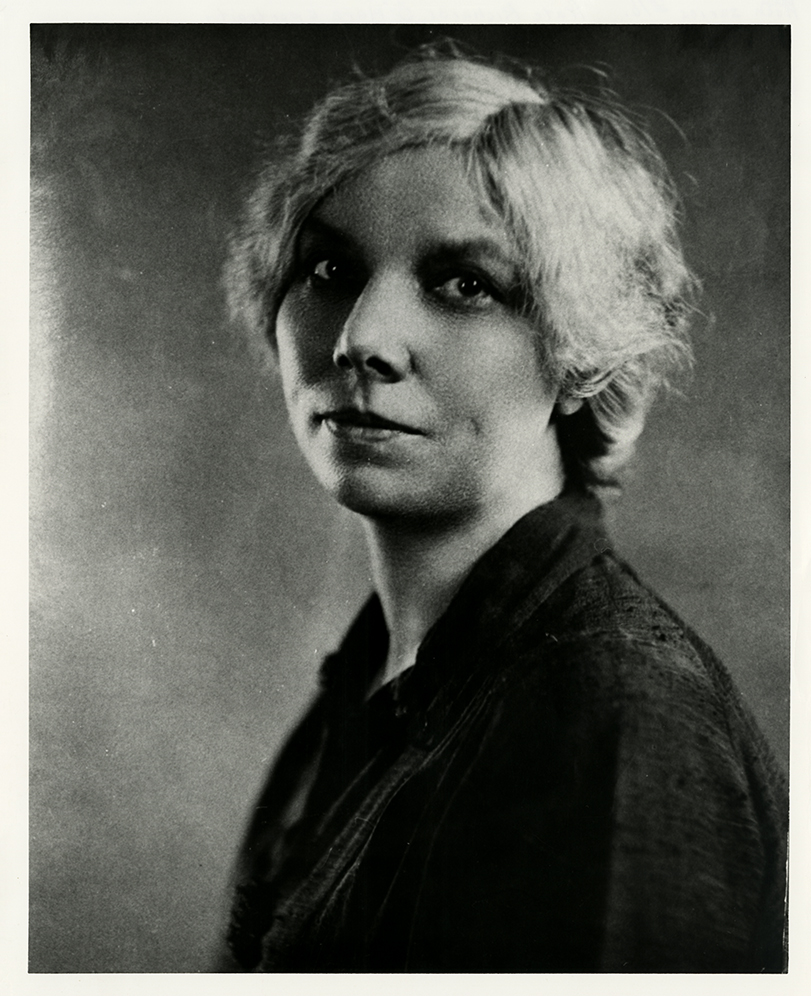
William Zeuch (left) and Kate Richards O’Hare (right).
Courtesy of University of Arkansas at Fayetteville Special Collections.
1925
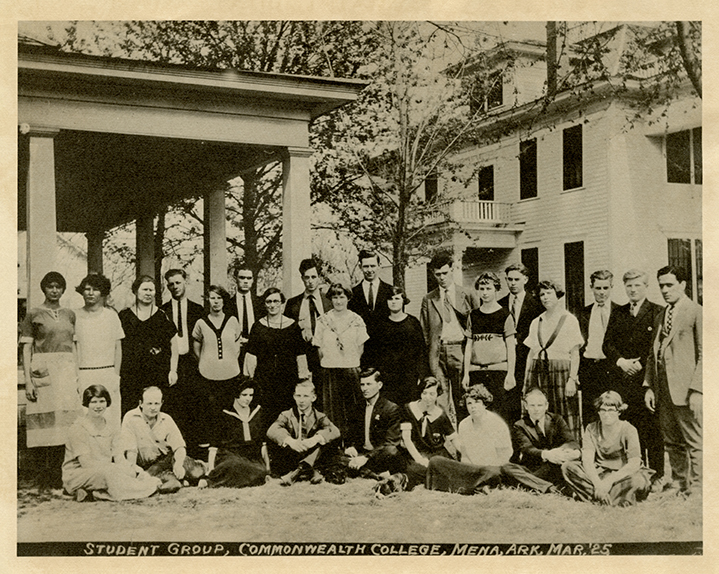
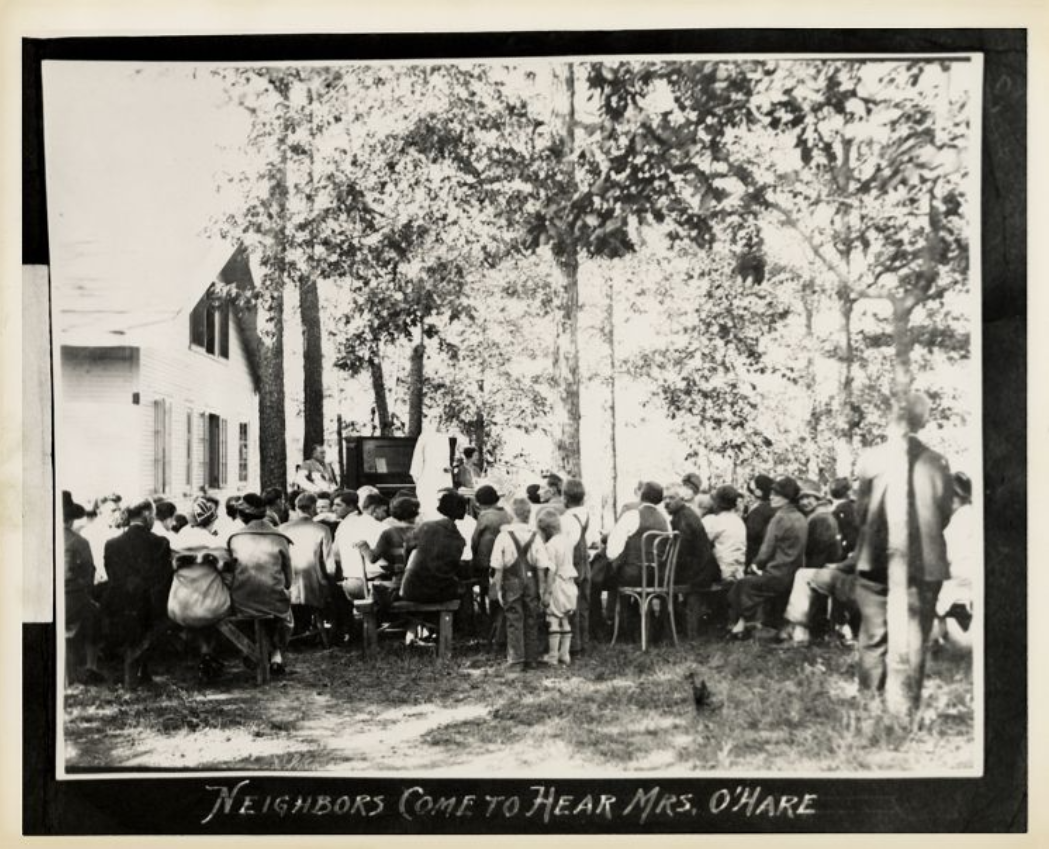

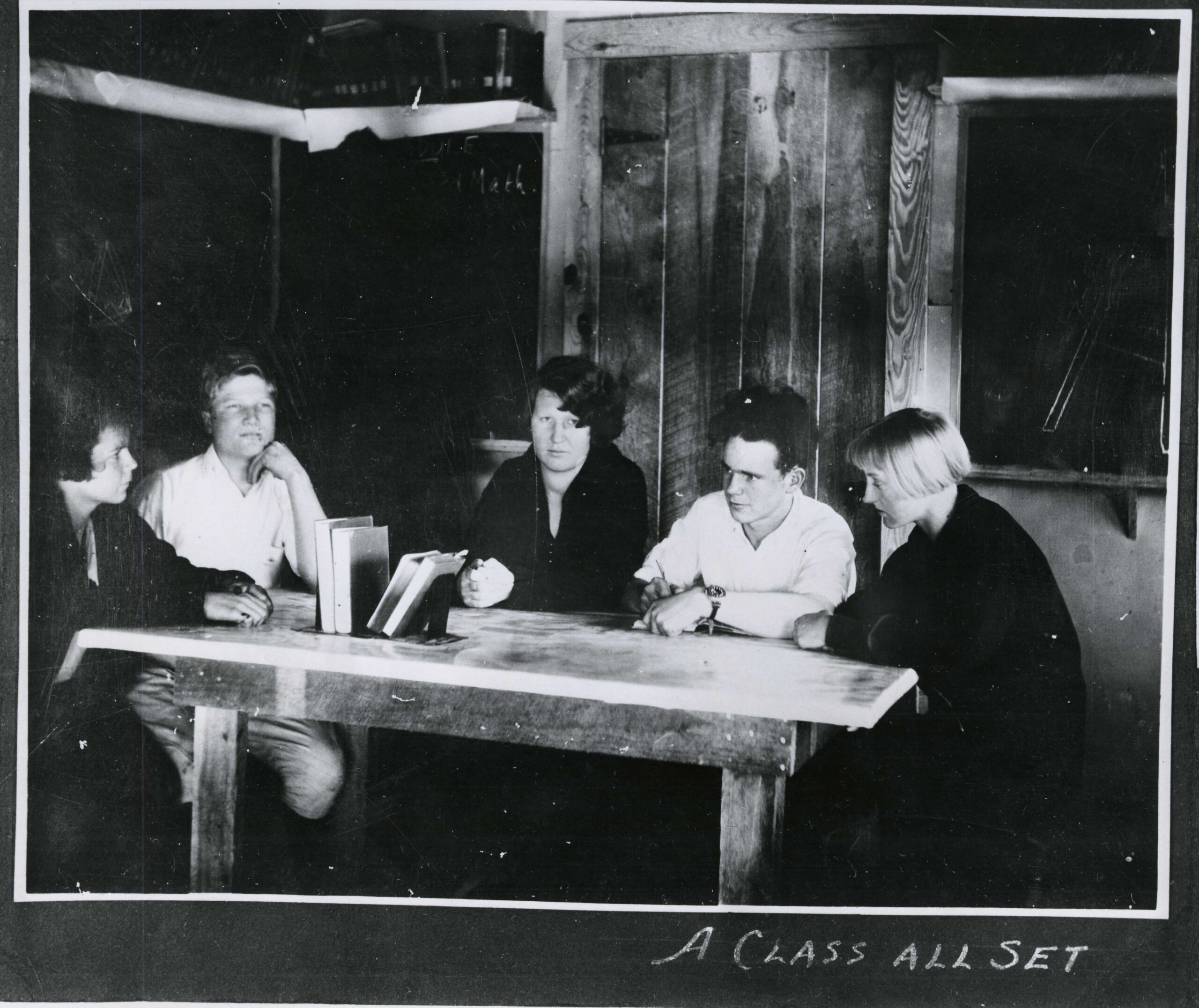
Commonwealth in Arkansas
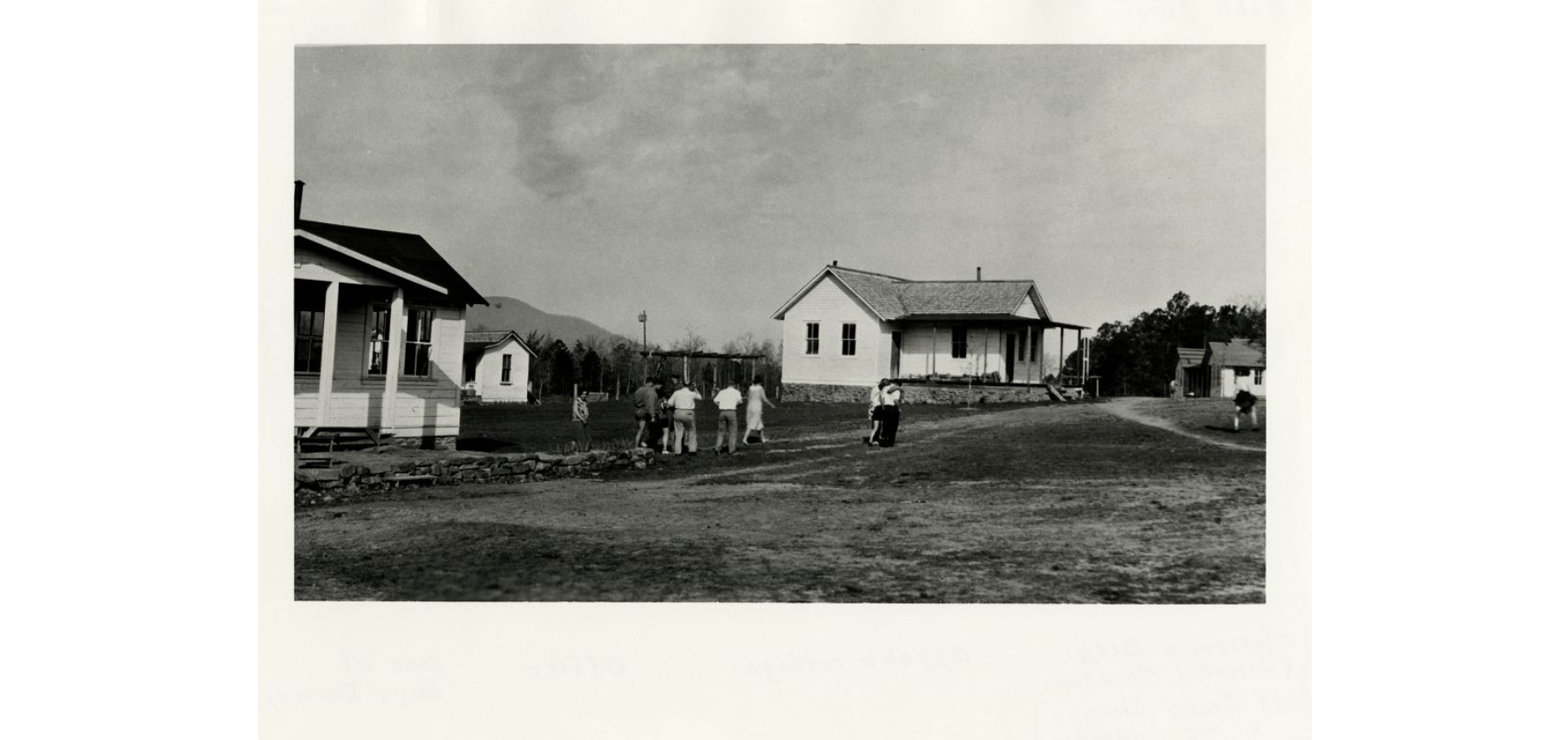
In 1925, Commonwealth began its operation on 80 acres west of Mena. William Clark Benton, the school’s history and law professor, described the land as having “a wonderful valley, perhaps a mile or more wide running up to the edge of Rich Mountain, watered by a beautiful creek, and it has fine farming land.”
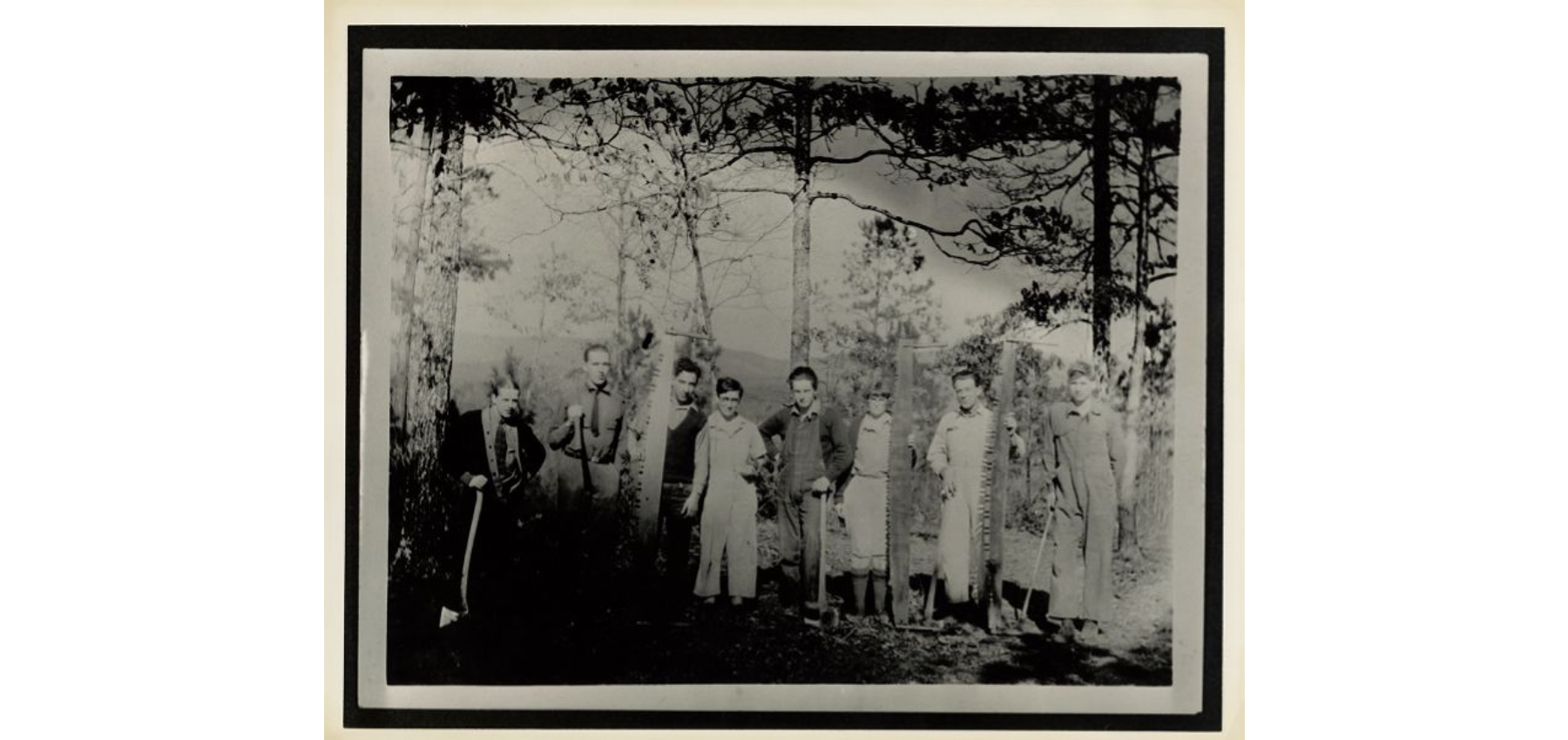
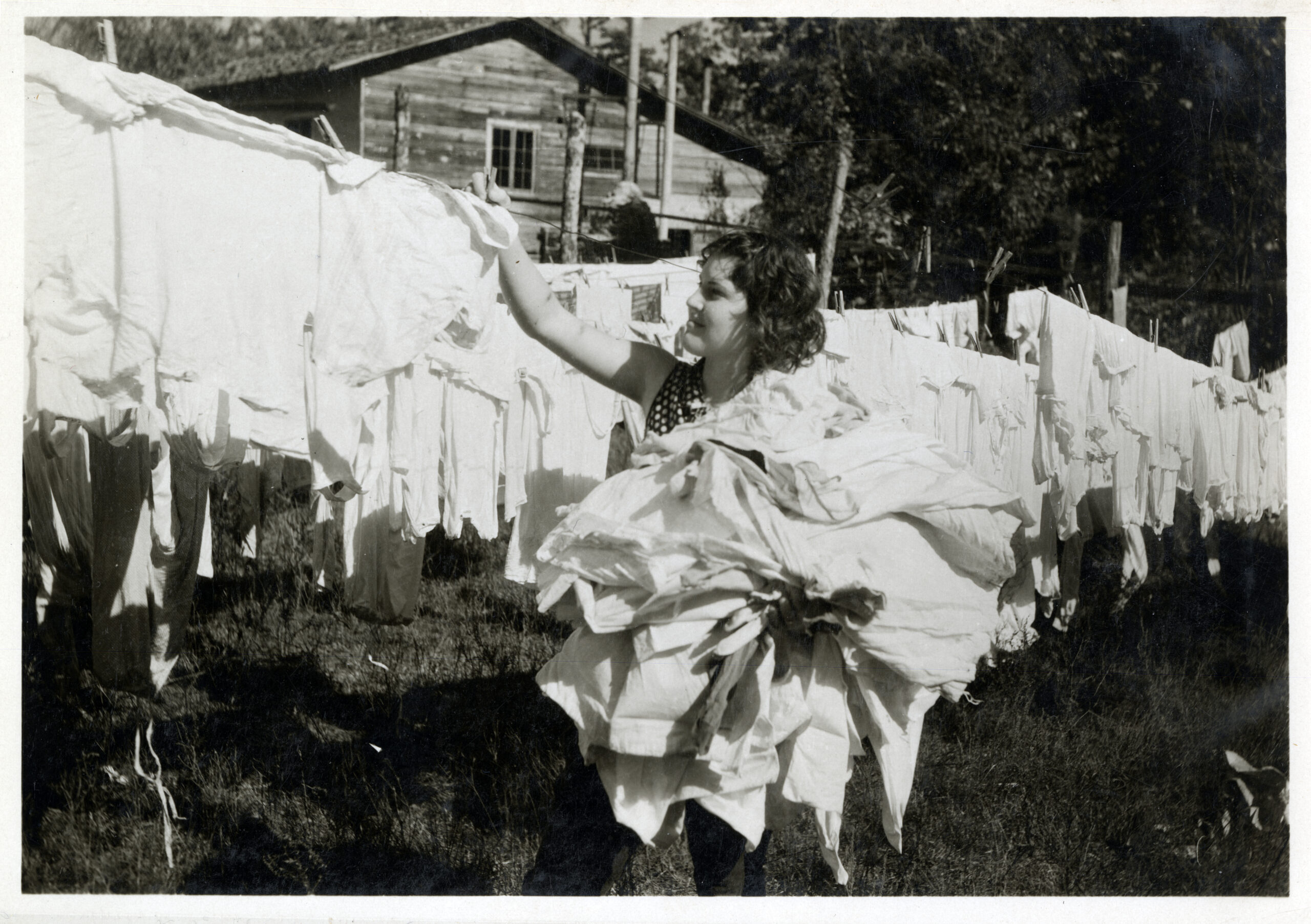
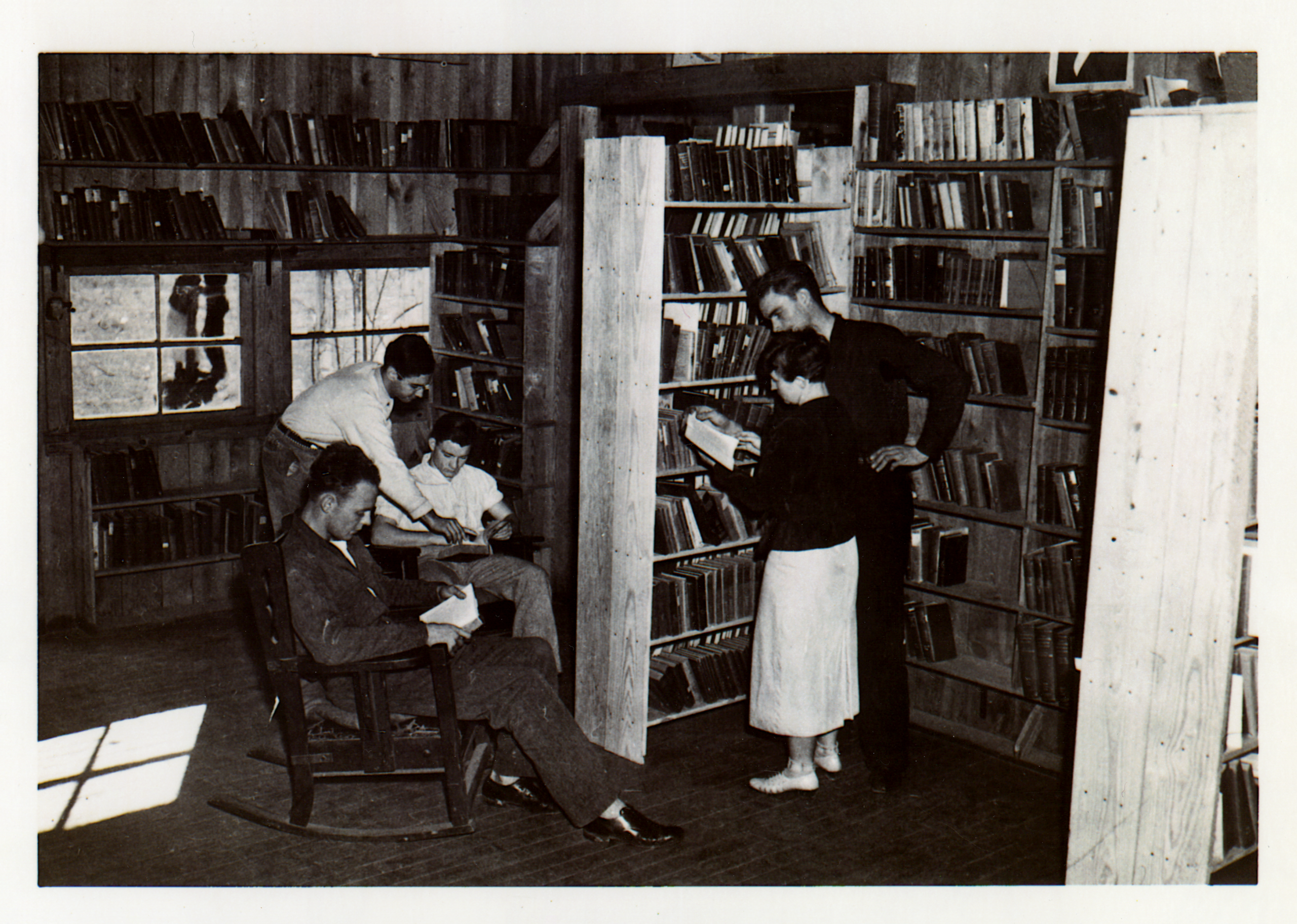
Students and faculty alike worked for a mandatory four hours per day to earn their keep at the residential school. Some prepared meals, washed laundry, or worked in the library; others worked on crews for farming, carpentry, or masonry. Professors received no wages, but only room and board, including laundry services.
Classes were small, informal, and structured primarily around group discussion. Students might have taken such courses as Public Speaking, Effective Writing, Labor Journalism, Economic History, or General Psychology. Commonwealth did not bestow degrees or give letter grades. The goal was for students to gain skills and knowledge to apply directly as labor organizers; or, as the Commonwealth College Fortnightly put it, “whatever the student gets he must carry away in his head.”
When classes were dismissed and daily chores complete, the Commoners spent their leisure time swimming at the nearby Mill Creek or organizing social events with the surrounding communities. Dances and theater performances were particularly popular among the Commonwealth’s neighbors.
Click here to learn more about Commonwealth College.
1935
Joe Jones at Commonwealth
On August 1, 1935, The Commonwealth Fortnightly reported that Joe Jones, “one of America’s outstanding revolutionary artists,” would lecture on proletarian art and culture during the summer session.
Jones, a St. Louis-born artist, began working as a house painter at the age of 14. These working-class roots shaped his art as he rose to national prominence in the 1930s. Amidst the Great Depression, Jones turned to art as a means of social engagement and protest.
As he prepared for his lectures, Jones had the idea to paint a mural for the college. Jones, accompanied by Commonwealth student Horace Bryan, embarked on a road trip across Arkansas to seek inspiration. The experience only strengthened his commitment to the workers of the South. Jones produced a 9 x 44 foot mural featuring what he considered the most pressing challenges Southerners faced. Three themes dominated the piece: the plight of industrial workers, racial violence against African Americans, and the exploitation of sharecroppers.
On August 31, 1935, after about three weeks of work, the mural was displayed to the public. When the campus gathered to unveil and celebrate the piece, Jones said, “[T]his mural is made possible only through my affiliation with and my attitude towards my class, and by the subject matter drawn from that class; whatever is here that is good comes from my class, the working class. In dedicating this mural I give it back to them, and particularly to the working class of the entire south.”
Click here for more information on Joe Jones’s life.
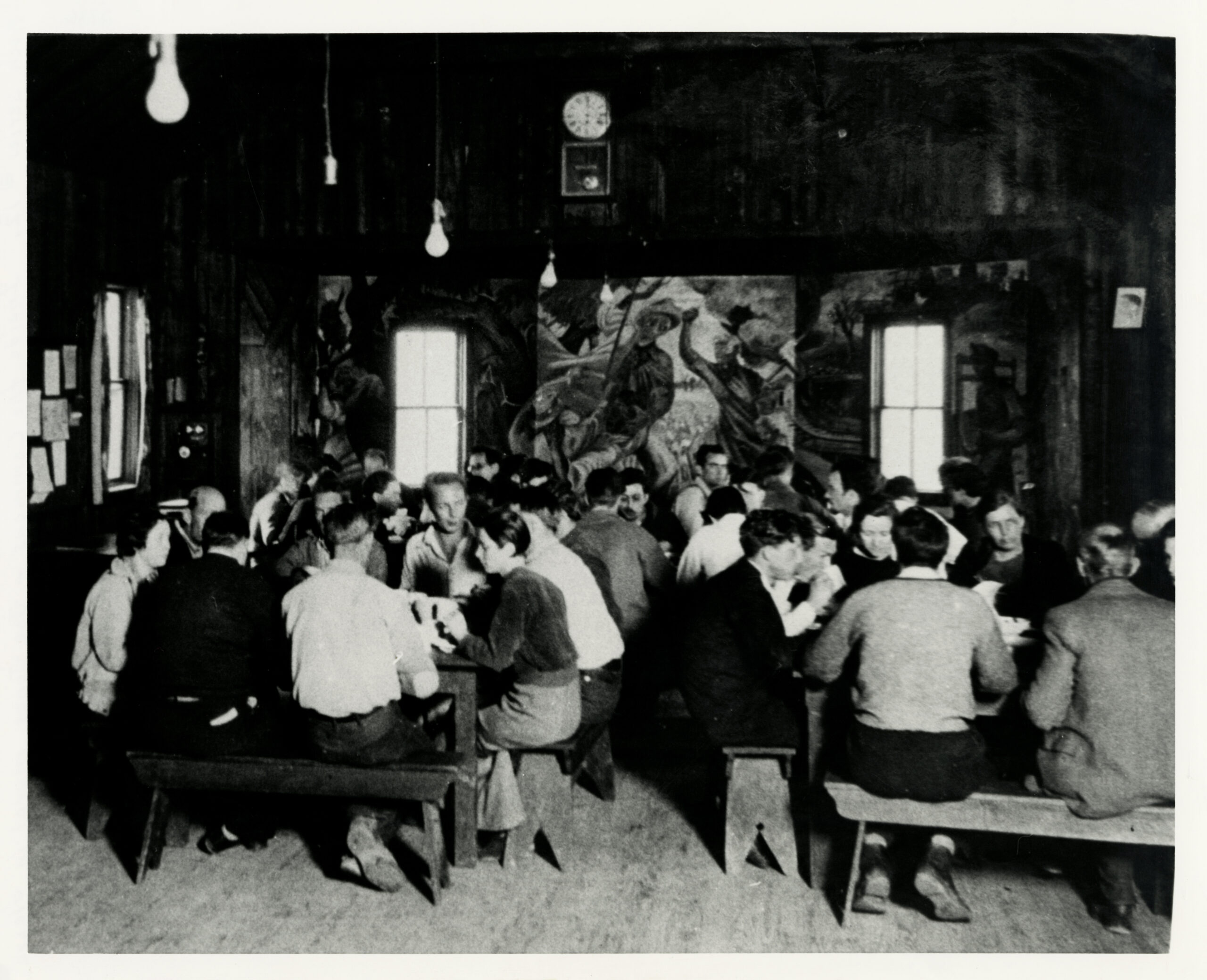
Students sitting in the common room with the mural in the background, ca. 1935-1940. Courtesy of UA Fayetteville Special Collections.
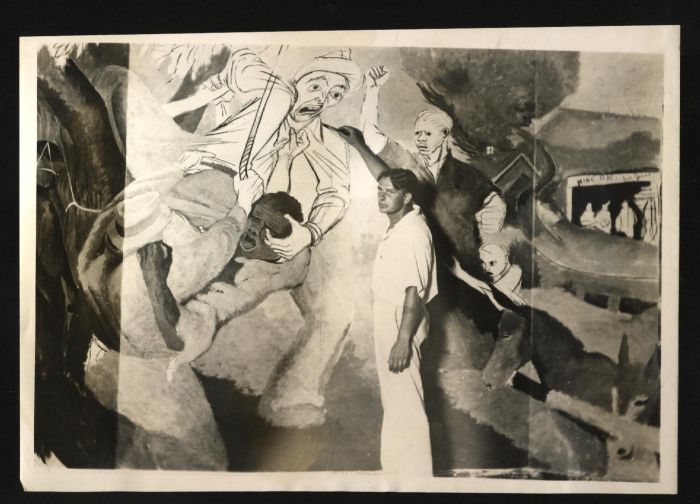
Joe Jones posing with the unfinished mural, 1935. Courtesy of the Joe Jones Family.
Click here for a transcription of the press release.
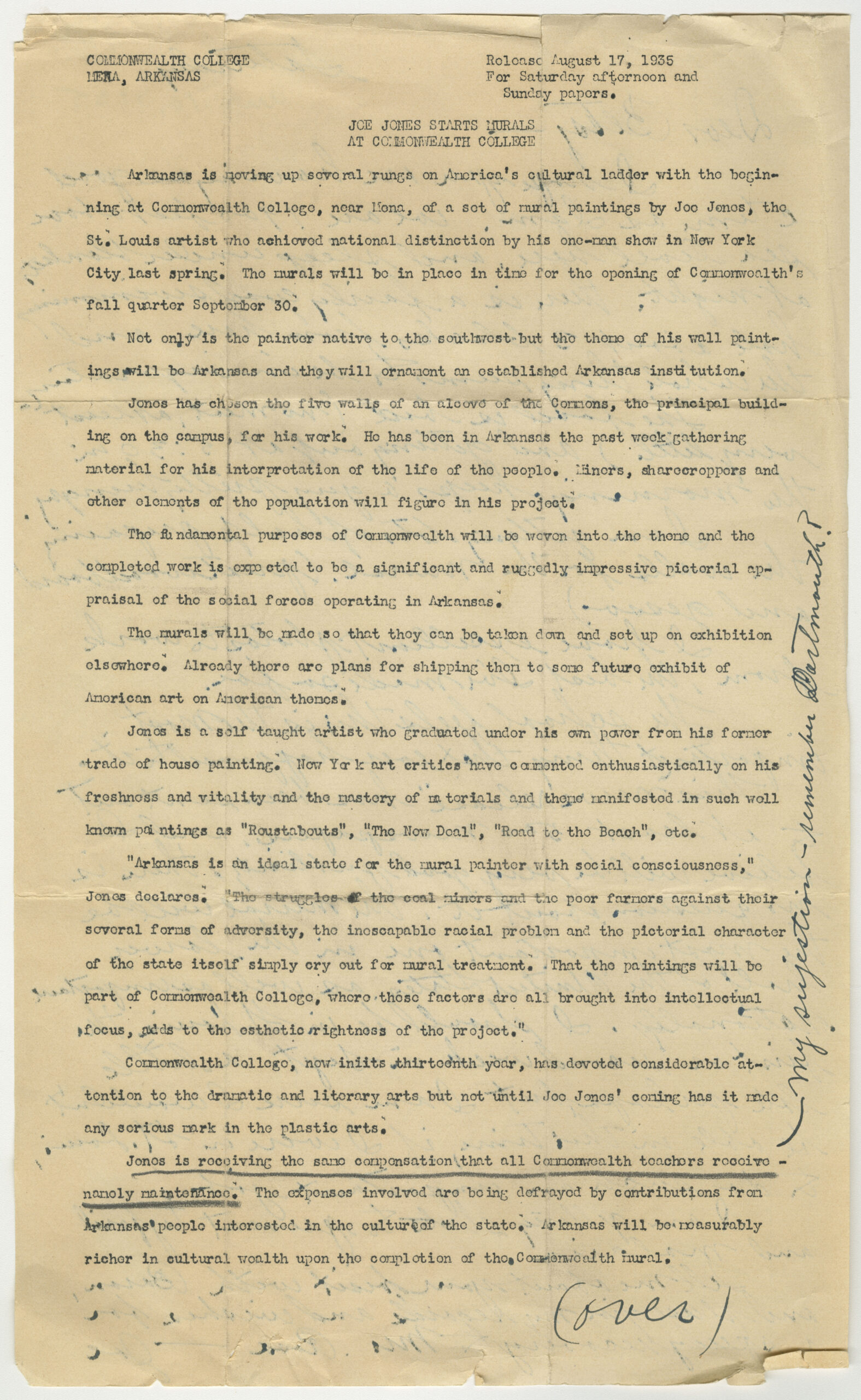
Press release from Commonwealth College announcing the plan for Jones’s mural. Courtesy of the Missouri Historical Society.
1925-1940
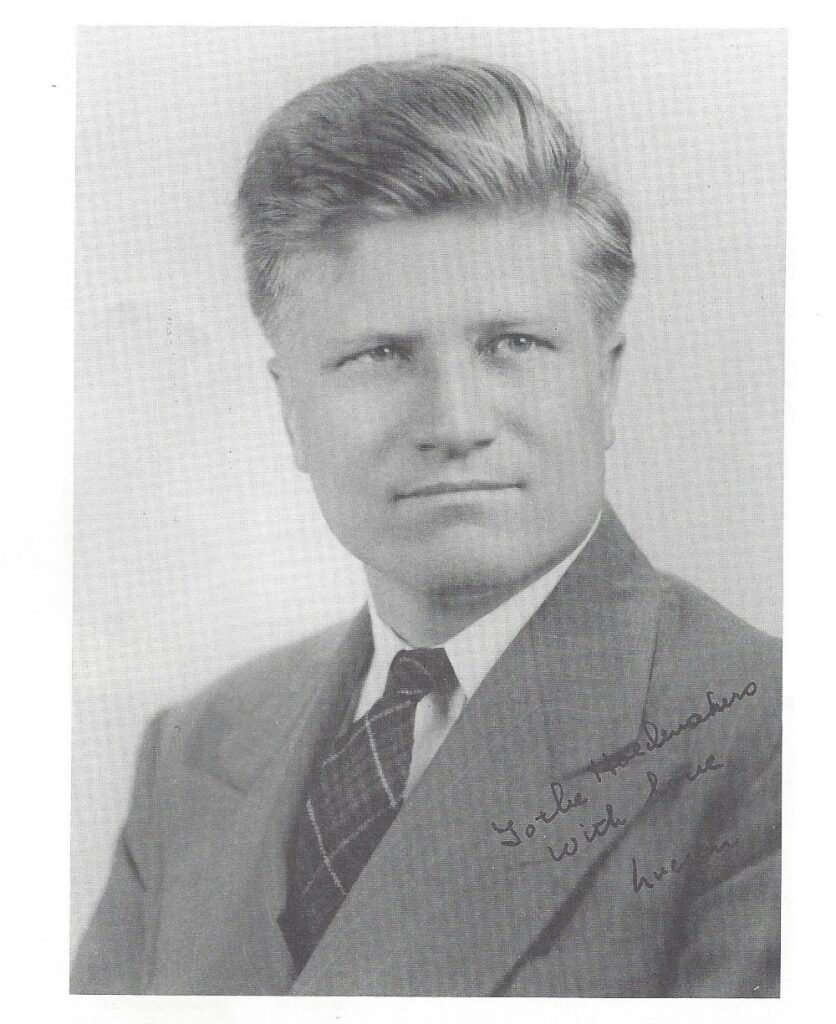
Lucien Koch, director of Commonwealth College from 1931 to 1936. Courtesy of the Personal Collection of Lucien Koch.
Tensions at Commonwealth College
Internal tensions and external pressures marked the fifteen years of Commonwealth’s existence in Arkansas.
After Zeuch’s departure in 1931, Lucien Koch took Commonwealth in a new direction. He emphasized active engagement in the labor movement but continued the tradition of ideological neutrality. While some Commoners shared Koch’s vision, others pushed for party alliances. In 1935, Commonwealth partnered with the Southern Tenant Farmers’ Union, an organization fighting against the exploitation of tenant farmers established in Tyronza in 1934. Koch hoped that supporting the vulnerable workers of the South would unite politically divided Commoners. The partnership, however, grew complicated and further highlighted ideological divisions. After Koch left in 1936, several directors attempted to stabilize Commonwealth’s shaky financial and political situation. The most prominent among them was Presbyterian minister Claude Williams, known for his fiery sermons on the workers’ plight.
Commonwealth was repeatedly accused of ties to communism and even of being funded by the Soviet Union. Although an FBI investigation revealed no such connections, the school’s reputation was tarnished. That led to worsening relations with the Polk county neighbors. After years of relatively friendly coexistence, the local community led by Baptist minister Luther D. Summers turned against the Commoners too.
After years of rising tensions, financial troubles, and failed attempts at reorganizing, the school closed in 1940.
1940
Commonwealth College Closes its Doors
On December 16 and 19, 1940, Polk County officials held auctions to sell materials from the school and settle court fines. Neither the mural nor the Masonite panels it was painted on are listed among the property for sale on the auction notices.
A commonly repeated story suggests that a faculty member’s daughter took the mural down and transported the panels to a house, possibly in Mena. However, given the mural’s size, it is unlikely a single person was able to move it and no known records documenting what happened to the mural following Commonwealth College’s closure exist. For the next four decades, Jones’s mural was lost.
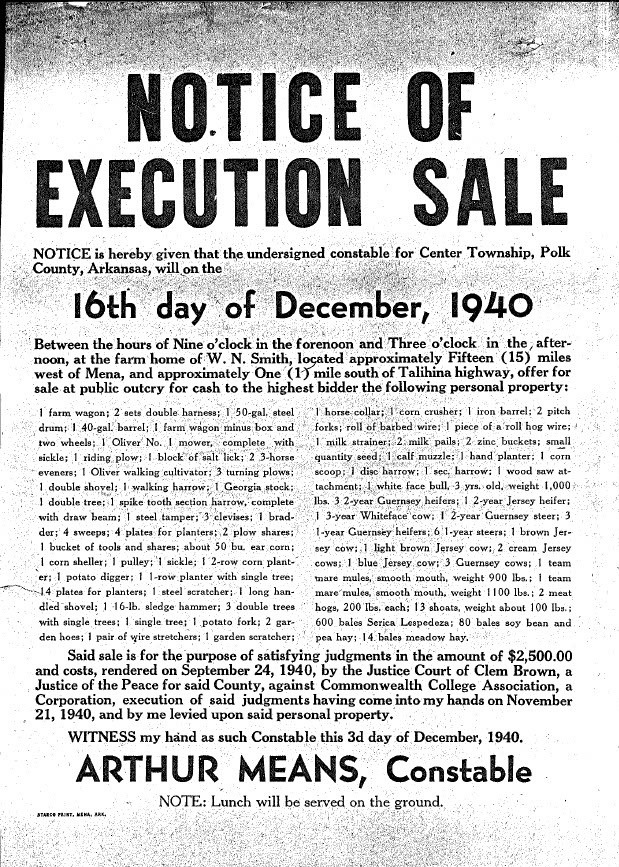
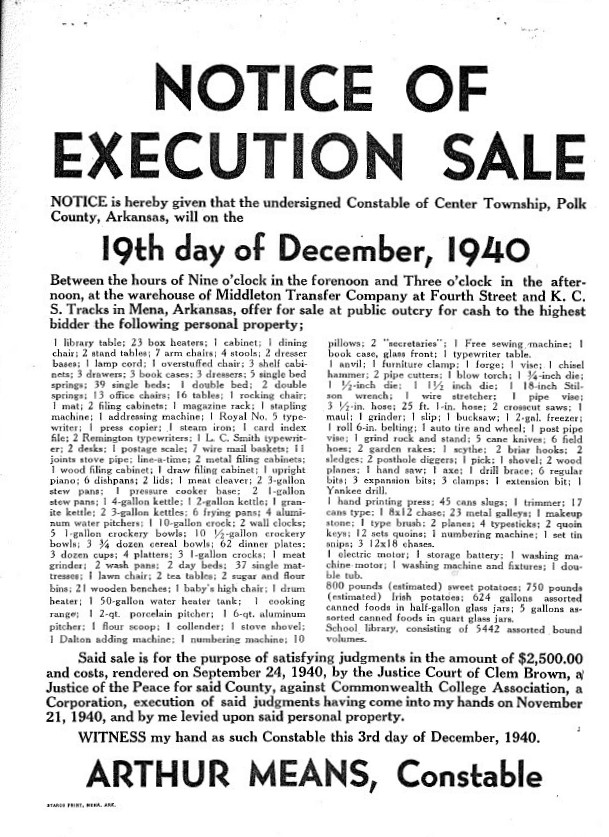
Notices of Execution Sales for Commonwealth College. Courtesy of UA Fayetteville Special Collections.
1984
Recovering the Mural
In 1984, 44 years after Commonwealth College closed its doors, Bobby Roberts, at the time the head archivist at UA Little Rock, received a call from Fadjo Cravens, a manuscripts collector. Cravens told Roberts that the Commonwealth College mural had been pulled from a house in Mena, Arkansas.
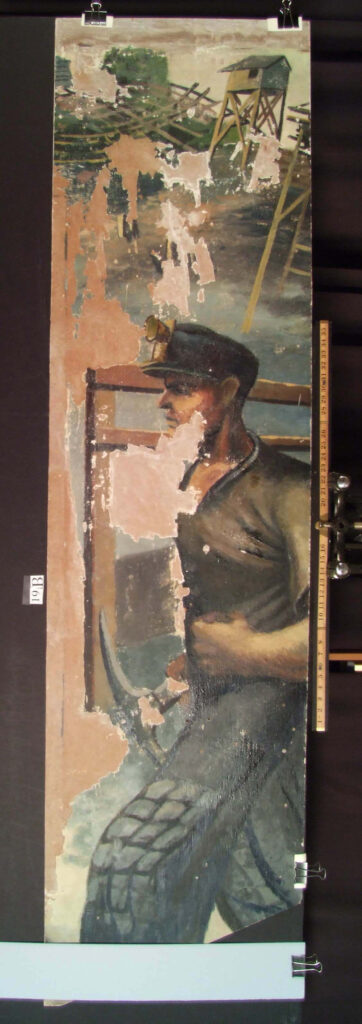
Roberts, historian by training, knew the story of Commonwealth and its lost mural. He immediately recognized the call’s significance. He arrived on the scene to find the mural in 29 fragments in the yard, with some sections covered in paint, wallpaper, and nail holes. Each fragment displayed clear signs of aging and environmental damage. The mural must have been used as a building material, possibly to insulate a space in the house, likely a closet or a storage room.
After settling on a price of $600, Roberts handed over a check, loaded the mural fragments into the van that he had checked out from the University, and took them back to Little Rock. The mural was stored in the University’s art storage area.
Click here to hear Roberts share his experience as an archivist at UA Little Rock and his role in saving The Struggle in the South.
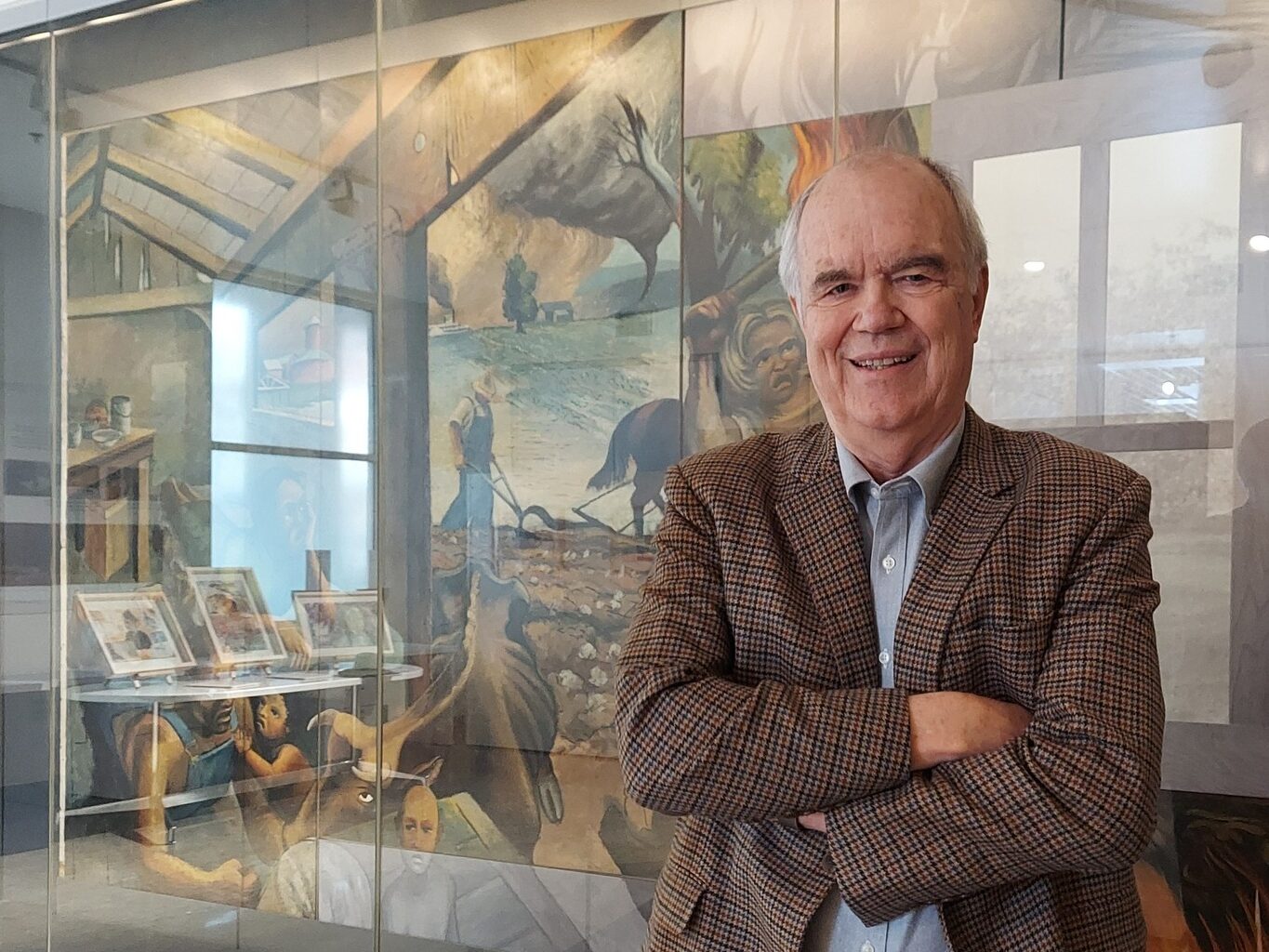
Bobby Roberts standing in front of the restored mural in December, 2023.
2009
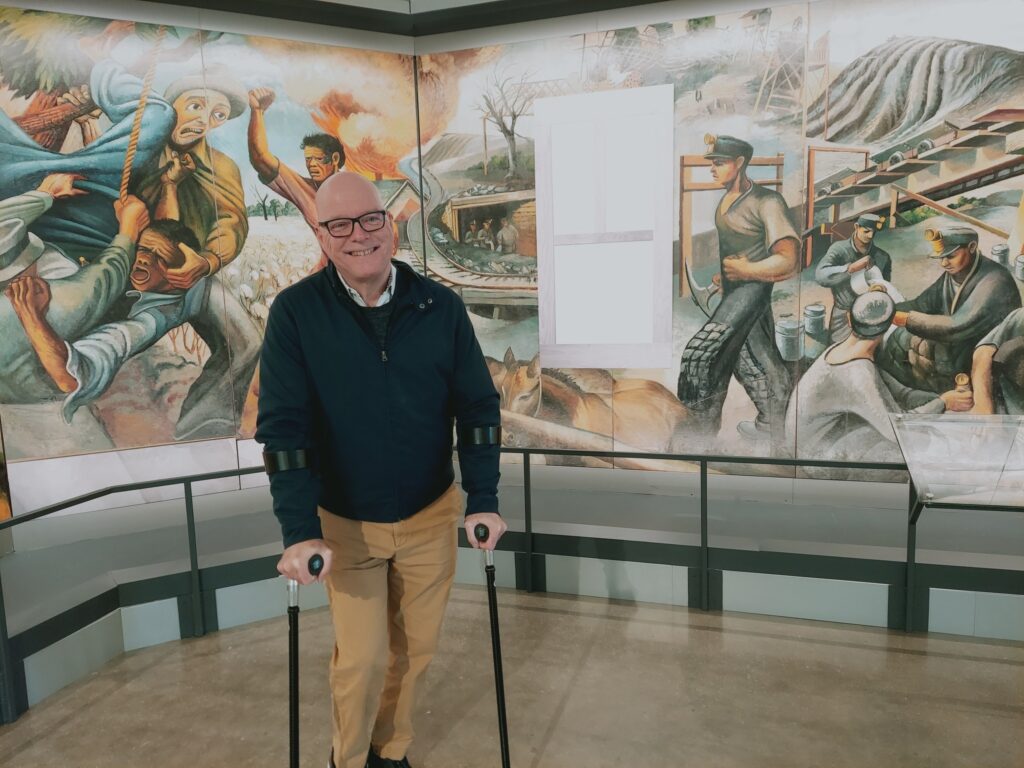
Brad Cushman standing in front of the restored mural, 2025.
From Storage to SLAM
The mural remained in the University’s art storage for another 25 years, too fragile to be excessively handled or moved. Brad Cushman, who served as the UA Little Rock Art Gallery Director for over two decades, remembered that he learned about the mural from a history student who wanted to research the piece. But Jones’s work was too delicate to work with directly. Cushman recalled that when he first saw the mural fragments, they looked like “eggshells crushed on a piece of Masonite.”
Click here to listen to Cushman recount his time at UA Little Rock and his role in the restoration of the mural.
2009 was a turning point for the Commonwealth mural. The St. Louis Art Museum (SLAM) was planning Joe Jones’s retrospective. They reached out to Cushman and arranged a visit to UA Little Rock. Andrew Walker of SLAM was not discouraged by the work’s fragile condition. He quickly convinced Cushman that SLAM should conserve the central panel of the mural, to be featured in the planned exhibition.
SLAM conservator Paul Haner spent nine months conserving the panel, eventually featured in the retrospective exhibition, Joe Jones: Painter of the American Scene. The exhibit, on display from October 2010 through January 2011, highlighted Jones’s most pivotal pieces created between 1930 and 1942.
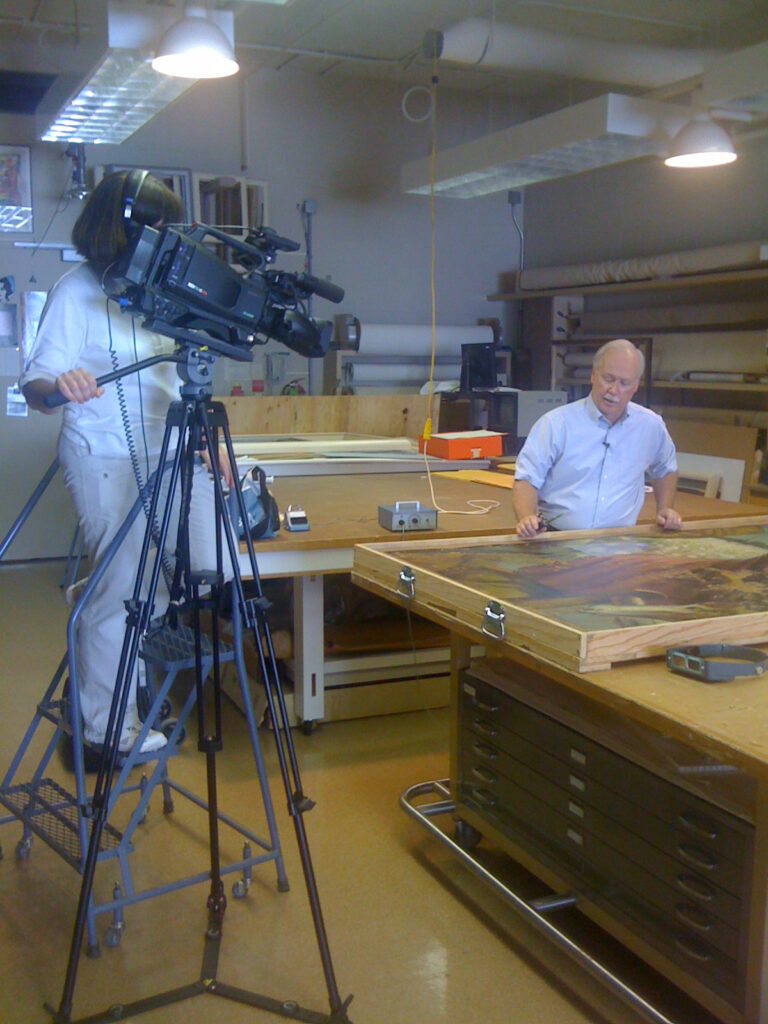
SLAM conservator Paul Haner working on the central mural panel. Courtesy of Brad Cushman.
2011-2016

Conservation
The restored section of the mural became the focal point of SLAM’s exhibition, renewing interest in Jones’s work and providing an opportunity for Cushman and his team to seek funding to continue the conservation efforts. The Arkansas Natural and Cultural Resources Council (ANCRC) provided a major grant to conserve the work. UA Little Rock recruited Helen Houp of Helen Houp Fine Art Conservation in Dallas, Texas, to conserve the mural.
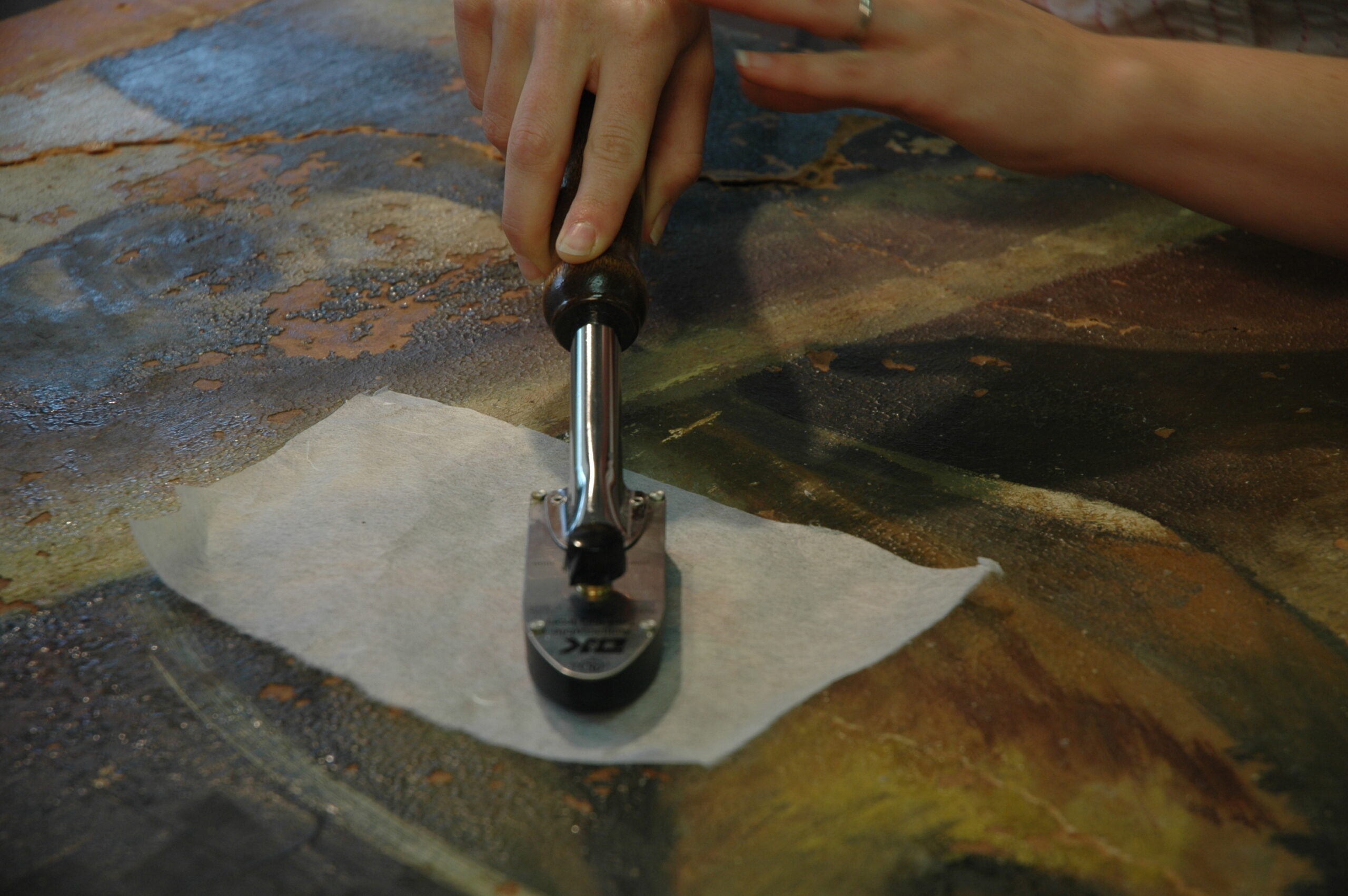
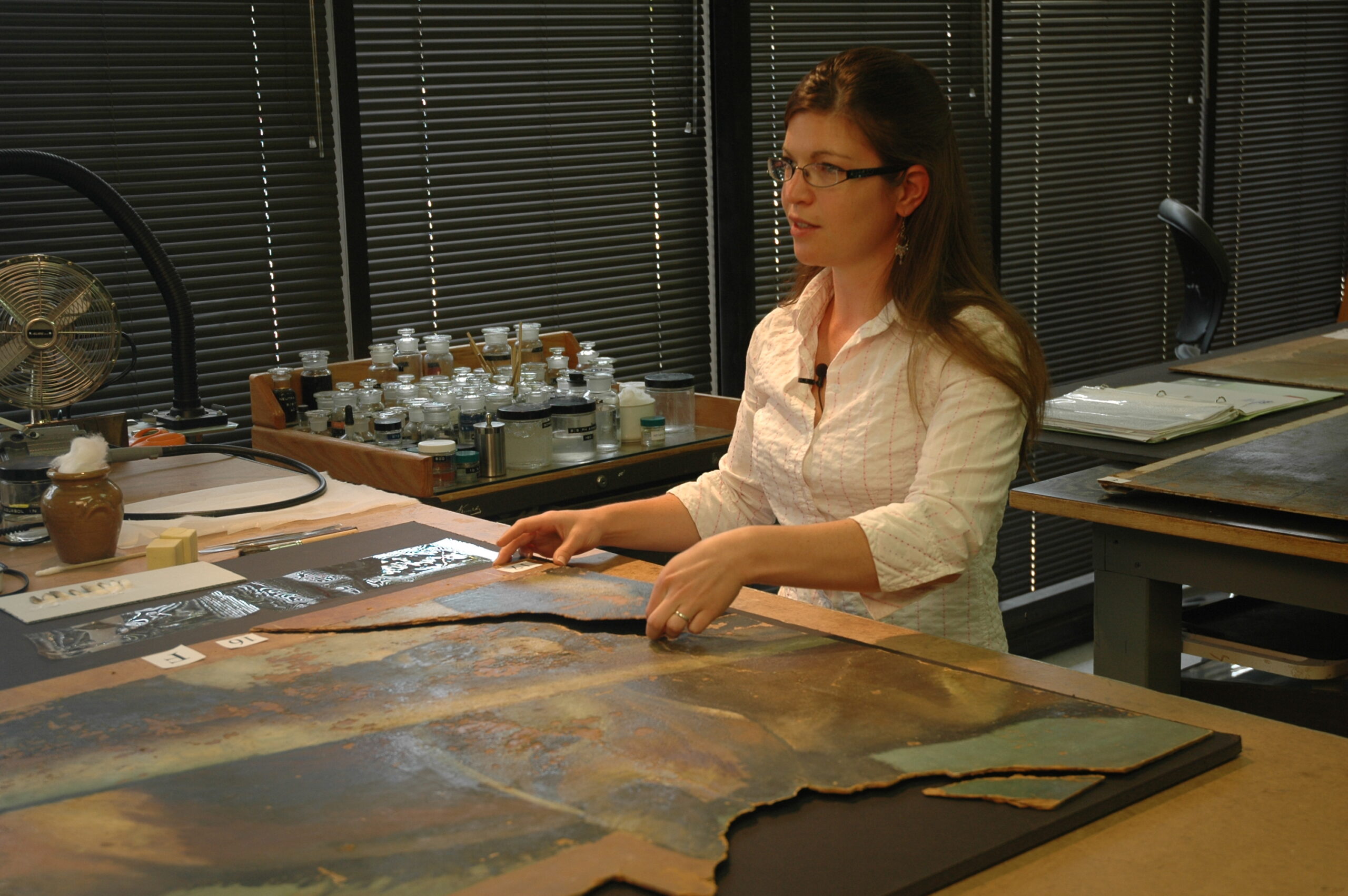
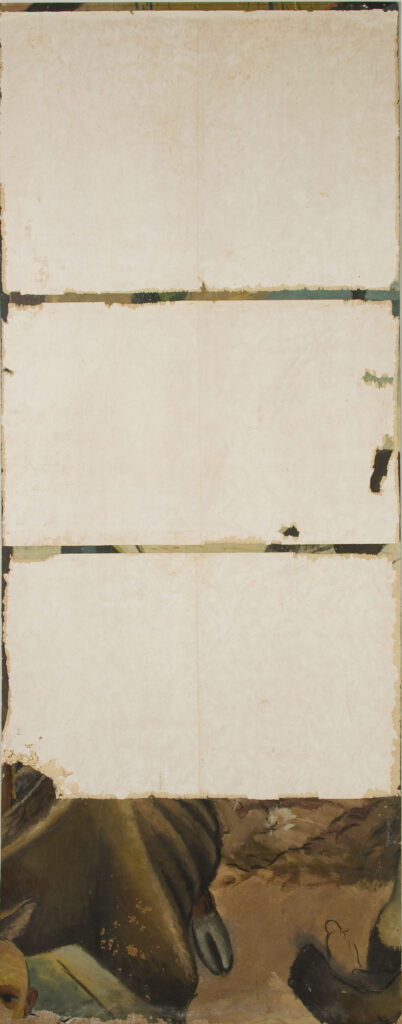
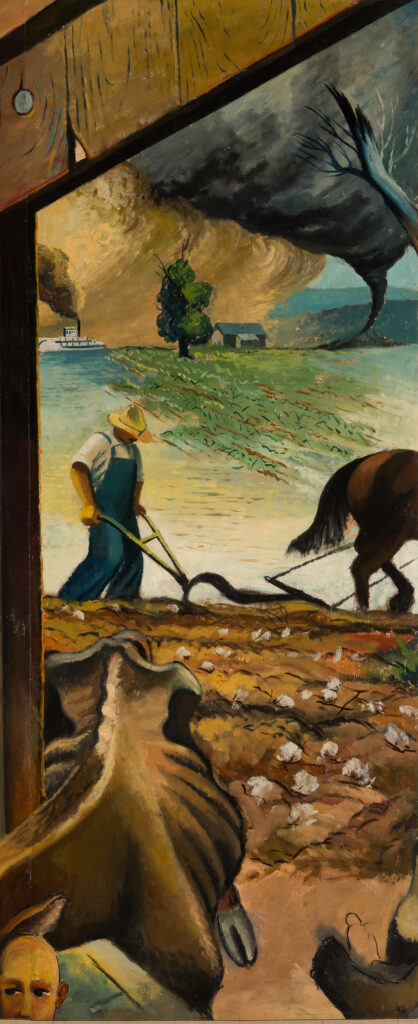
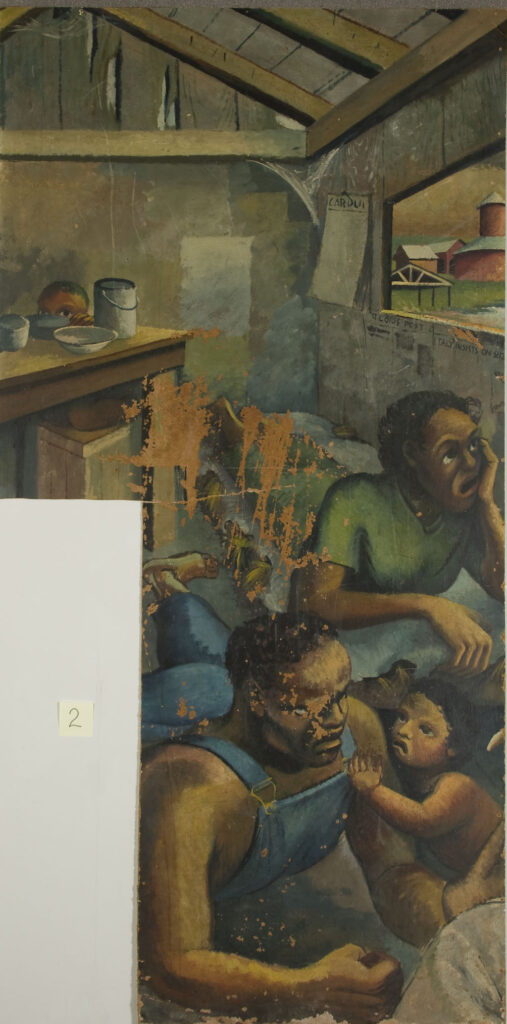
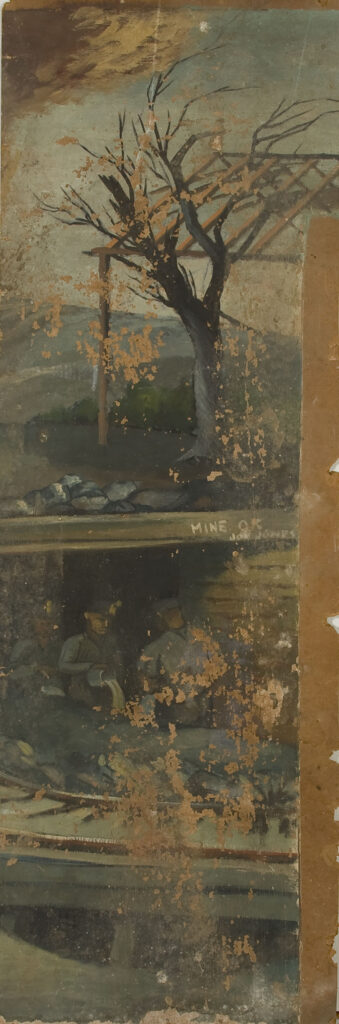
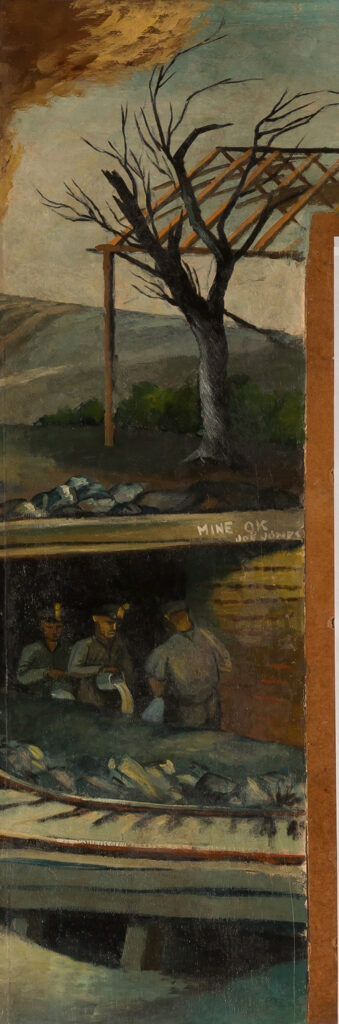
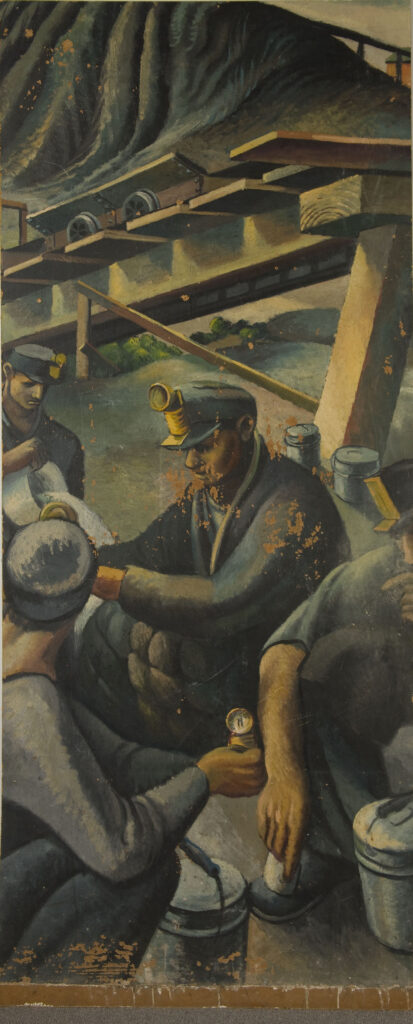
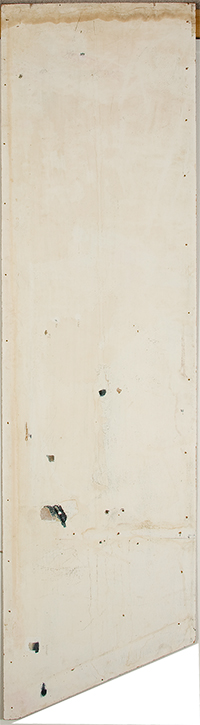
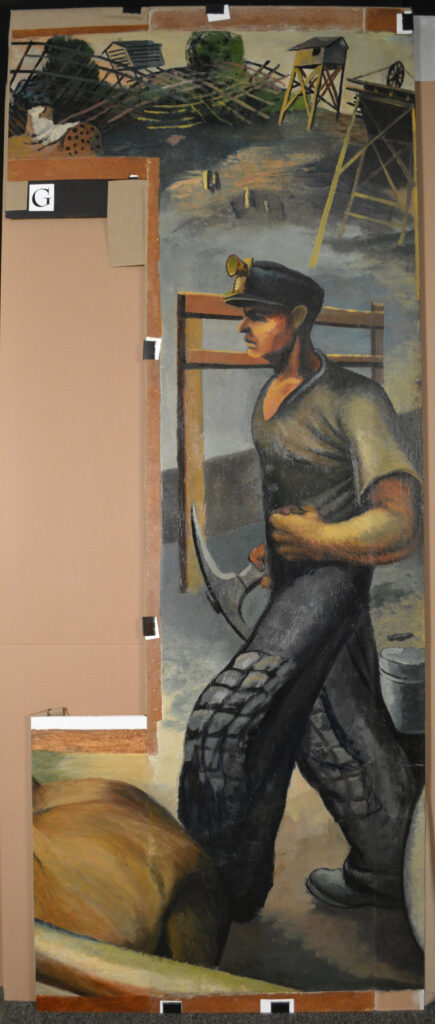
Houp and her team spent the next four years carefully removing wall paint and wallpaper, cleaning dirt and grime from the surface, stabilizing flaking paint, mending breaks, and flattening warped panels. In 2016, Houp and her team finished the conservation of Jones’s piece.
Although the mural is now referred to as The Struggle in the South, neither Jones nor the Commoners came up with the title. In fact, Jones never named the piece. Most contemporary coverage refers to the work simply as some variation of “the Commonwealth College mural” or “the Joe Jones mural.”
To some, the mural is known as Coal, Cotton, and Lynching: The Industries of Arkansas. Many familiar with the mural and its history, including Brad Cushman, confirm they have heard this title. However, its origins remain a mystery.
The mural’s current title comes from the October 1935 issue of New Masses, a radical leftist monthly. Underneath a story on a textile workers strike in Pelzer, South Carolina, the magazine featured a photo of the mural across a two-page spread. The caption beneath the photo read “The Struggle in the South.” This caption was eventually co-opted and popularized as a title during the mural’s restoration.
Click here to see the mural’s transformation.


2018
Joe Jones at UA Little Rock Downtown
The remaining task was to find a permanent home where the mural would be accessible to scholars, students, and members of the public. Brad Cushman, who was instrumental to conserving the piece, recalled that even before the conservation process was completed, it was clear the mural should serve as the focal point of a space of civic reflection.
In 2018, UA Little Rock Downtown opened in the heart of Little Rock’s River Market district. The goal of the Downtown center was to connect the University’s main campus to the city’s central districts and to serve as an interdisciplinary hub of learning, community engagement, and civic reflection.
The Struggle in the South was installed at UA Little Rock Downtown in late 2018 and officially unveiled to the public in January 2019. In accordance with the mission of UA Little Rock Downtown, the mural room provides a space to engage with the past and present communities of Arkansas and beyond.
The mural is available for public viewing at UA Little Rock Downtown. We encourage all, including educators, to reach out to learn more about how to engage with this important piece of Arkansas history. Email [email protected] to schedule a visit or to learn more about programming related to the mural.
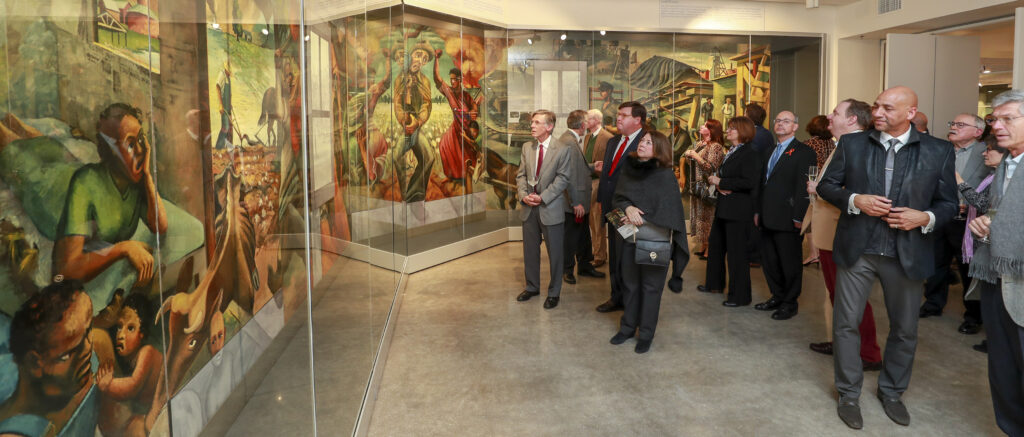
UA Little Rock Downtown opening event in 2018.
Additional Resources
- Cobb, William H. “Commonwealth College Comes to Arkansas, 1923-1925.” Arkansas Historical Quarterly 23, no. 2 (1964): 99-122.
- Cobb, William H. Radical Education in the Rural South: Commonwealth College, 1922-1940 (Wayne State University Press, 2000).
- Marling, Karal Ann. “Joe Jones: Regionalist, Communist, Capitalist.” Journal of Decorative and Propaganda Arts 4 (1987): 46–59.
- Wolfe, Melissa M. “Joe Jones, Worker-Artist,” in Joe Jones: Radical Painter of the American Scene, edited by Andrew Walker. (St. Louis Art Museum, 2010): 33-52.
About the exhibit
- Research, text, and digital exhibit design by Carlie Cowgill, UA Little Rock Downtown.
- Additional research and text by Marta Cieslak, UA Little Rock Downtown.