
In this lesson, students will examine how various New Deal critics justified their opposition to the New Deal, how their critiques were different from each other, and what they had in common.
Essential Questions
Why did some oppose the New Deal?
Background Knowledge
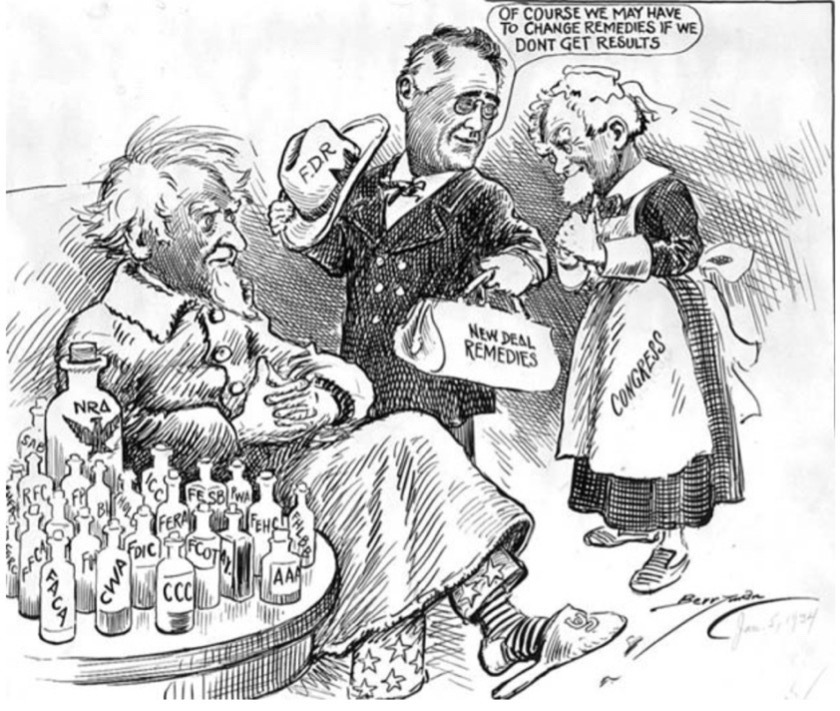
All New Deal programs, projects, legislation, and regulations were based on the principle of government intervention. Never before were the federal and local governments so directly involved in regulating the country’s economy and in the lives of ordinary Americans. Whether by creating jobs on government-led projects, funding states to create local relief programs, or regulating such issues as work hours, minimum wage, or labor safety codes, the New Deal placed the government in the center of efforts to alleviate the impact of the Great Depression.
Great Depression from Encyclopedia of Arkansas: https://encyclopediaofarkansas.net/entries/great-depression-4237/
Selection of short videos from Ken Burns’s films (PBS) grouped by themes:
New Deal: https://www.pbs.org/kenburns/unum/playlist/new-deal
Great Depression: https://www.pbs.org/kenburns/unum/playlist/great-depression
Franklin D. Roosevelt: https://www.pbs.org/kenburns/unum/playlist/franklin-d-roosevelt
“New Deal Critics” by Michael Parrish, Bill of Rights Institute: https://billofrightsinstitute.org/essays/new-deal-critics
Meg Jacobs, “What few people know about the program that ‘saved’ America” (A short TED-Ed video that explains the basics of the New Deal: https://www.youtube.com/watch?v=VWvA26V4wk0
Learning Objectives
By the end of this lesson, students will:
- Identify major individual and group voices that opposed the New Deal.
- Outline the reasons for opposing the New Deal.
- Determine how a person’s or a group’s political views and/or experience shaped their critique of the New Deal.
Key Terms
FDR – Franklin Delano Roosevelt; the 32nd president of the United States from 1933 until his death in 1945. His presidency overlapped with the Great Depression and World War II.
New Deal – A series of programs, projects, and regulations that aimed to improve the US economy during the Great Depression. Enacted by President Franklin D. Roosevelt between 1933 and 1939.
Great Depression – Worldwide severe economic crisis that lasted from 1929 to about 1939.
List of alphabet agencies:
Agricultural Adjustment Administration (AAA) – Cash incentives to limit farm production.
Federal Emergency Relief Administration (FERA) – Direct cash assistance to state relief agencies.
Civilian Conservation Corps (CCC) – Young men employed on conservation and reforestation projects.
Works Progress Administration (WPA) – Unemployed men and women worked on projects designed and proposed by local governments.
Tennessee Valley Authority (TVA) – Hydroelectric dams to control flooding and distribute electricity. Offered training and education classes to improve agricultural practices and take advantage of new job opportunities.
National Recovery Administration (NRA) – Tasked with creating industry-wide codes intended to eliminate harmful and unjust trade and labor practices.
Public Works Administration (PWA) – Grants-in-aid to local governments for large infrastructure projects, such as bridges, tunnels, schoolhouses, libraries, etc.
Farm Security Administration (FSA) – Designed to assist poor farmers during the Dust Bowl and the Great Depression. Most famous for a program documenting the lives of American farmers in a series of black-and-white photographs.
Primary Sources
Sources included in this lesson present perspectives across political and social spectrum. We encourage teachers to choose the sources that best align with their classroom goals.
Procedures
1) Starter
Students complete a matching activity of alphabet agencies. When they complete the task, ask what they all have in common.
Hint: Government intervention as the central principle behind the New Deal.
2) Guiding questions (“What did we do today?”)
– Who were the opposition groups to the New Deal?
– What were the reasons for opposing the New Deal?
– Why did some individuals and groups oppose the New Deal?
3) Background information
By 1935, the New Deal was provoking strong opposition across the political spectrum. Those who traditionally opposed government intervention regarded the New Deal programs as infringing on the rights of the individual. Others argued that the government did not go far enough. Right-wing populists, like Huey Long and Father Charles Coughlin, proposed their own versions of government action. Long suggested the taxation of the rich and the redistribution of wealth to empower American families to spend more money and heal the economy by robust consumption. Coughlin suggested the government takeover of major industries, while also sending anti-Semitic messages. On the left, progressives and socialists argued that the New Deal programs did not help the poor because its benefits stayed in the hands of powerful landlords and business owners. African Americans noted that Black Americans were repeatedly excluded from the New Deal programs. At the heart of each critique, the federal government was held responsible for failing to fix the economic crisis.
4) Activities
Station activity:
Divide students into groups. Each group gets one primary source, which presents a particular critique of the New Deal. Each group does an analysis together. Each group either presents their position or moves to the next station, where they analyze the next source. The first option exposes students to various critiques of the New Deal by exchanging their findings. The second option directly exposes all students to a larger variety of primary sources.
Or, within each group, every student reads a different critique, and presents their critique to others in the group.
One student in each group may also act as the government, who needs to defend the New Deal.
5) Rubric
[1 – 5] Exceeding/proficient/novice/emerging/unsatisfactory
Were you engaged and actively participating?
Can you articulate the understanding of key concepts?
Can you accurately identify examples of each concept?
Can you critique the New Deal using historical examples?
Assessment
What did you know? What do you want to know? What did you learn? – Write on a piece of paper. [KWL]
Exit ticket: Would you support the New Deal? Explain.
Reflection
Where do you see the enduring legacy of the New Deal or the New Deal critique today?
Which of the New Deal critiques did you find most convincing? If none, why?
Extension Relevance
Using the Internet, find a building or another structure (e.g., park, bridge, piece of artwork) that was built in Arkansas as a result of a New Deal program.
Arkansas Social Studies Standards
| US History | Era 8: 1929-1945, The Great Depression and World War II – United States during and following these major events | H.5.USH.3 H.5.USH.4 |
| African American History | Era 8: 1929-1945, Seeds of Change – African American experience (1920-1950) | H.5.AAH.2 |