
This lesson introduces students to the meaning and function of protest art. We define protest art as creative works that advocate for a cause, raise social awareness, and encourage the audience to take action.
Essential Questions
What is the purpose of protest art?
How can art influence social change?
Possible answers:
– To educate/raise social awareness.
– To shed light on the plight of the people we might not be familiar with.
– To challenge our complacency.
– To challenge societal norms.
– To inspire change in individuals or collectives.
– To advocate for change.
– To encourage us to act and engage with our communities and beyond.
Background Knowledge
Protest art are creative works that advocate for a cause, raise social awareness, and encourage the audience to take action to help the world become a better place for everyone, regardless of who they are or where they live. These creative works can be created in any medium, for example painting, drawing, sculpture, music, video, or performance, to mention just a few. Artists have always fought for justice and equality and they have always created art to bring attention to important societal issues. While art alone might not be able to solve problems that societies and individuals face, it may shed light on these problems, especially when artists create protest art in public spaces where everyone can easily see it. The goal of protest art is to question how things are, draw our attention to issues that societies need to address, and imagine a world where all can live healthy and stable lives.
What is Protest Art? by Tate Kids: https://www.youtube.com/watch?v=1_iqS_disW0.
Learning Objectives
By the end of this lesson, students will:
- Determine the goals of protest art.
- Name various elements of protest present in different examples of art.
- Provide examples of symbols of protest.
- Explain why artists use symbols.
- Explain what symbolism is.
Key Terms
Protest art – Creative works produced to draw attention to social or political issues and encourage the audience to address these issues.
Symbol – In art, a thing that represents or stands for something else.
Symbolism – The practice of representing things by other things (symbols).
Imagery – The use of words or pictures in books, movies, paintings, etc. to describe ideas or situations.
Mural – Any graphic artwork that is painted or applied directly to a wall, ceiling, or other permanent surface.
Social justice – The view that everyone deserves equal opportunities and rights.
Materials
Examples of protest art:
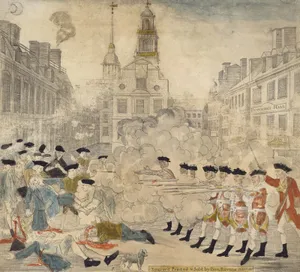
Political rights: Paul Revere, The Boston Massacre, 1770 (National Gallery of Art).
Revere’s engraving depicting the Boston Massacre was first published in the Boston Gazette in 1770. The image of British soldiers attacking Bostonians encouraged anti-British sentiments. As the image got distributed across colonies, it became a key piece of anti-British propaganda during the Revolutionary War.
Civil Rights: The Black Power Salute by Tommie Smith and John Carlos at the 1968 Olympics in Mexico (Black Past).
The famous photo can be seen as a piece of art or you may show students art inspired by the gesture and the photo (e.g., mural, print, or statue in the Museum of African American History in Washington DC). The linked article from Black Past explains how what Smith and Carlos were wearing that day was part of their protest. This suggests the gesture was a carefully planned performance, which can be seen as art too.
Anti-war: Martha Rosler, Cleaning the Drapes, 1967-72 (The Museum of Modern Art)
This piece comes from the series House Beautiful: Bringing the War Home, which Rosler distributed at anti–Vietnam War demonstrations.
Patients rights/AIDS activism: Keith Haring, Ignorance = Fear / Silence = Death, 1989 (Whitney Museum of American Art)
Keith Haring was a street artist, whose own HIV diagnosis in 1987 turned him into one of the most recognizable AIDS activists at the time when most feared the disease and patients struggled to secure proper medical care. Haring also stated that creating art helped him deal with his own diseases and the loss of friends and loved ones to HIV/AIDS.
Feminism: Barbara Kruger, Untitled, 1990 (The Museum of Contemporary Art, Los Angeles)
Barbara Kruger has pioneered using advertising design in her art, making it recognizable and accessible to many, including the individuals who never engaged with traditional elite art in museums.
Environmental rights: Banksy, untitled, 2018 (air pollution mural, Eco Watch)
Banksy is perhaps the most famous guerrilla artist in the world. We do not know his name or true identity. It is believed that he is British. Click here to see a clever reveal of the mural that encourages viewers to think of how perspective might change the meaning of art. Banksy confirmed on his verified Instagram account that the artwork was his.
Visual analysis:
Visual Thinking Strategy (VTS) [This activity can be done verbally, or students take notes; learn more about VTS from GVSU Art Museum].
Three key questions at the core of VTS:
– What’s going on in this picture?
– What do you see that makes you say that?
– What more can we find?
After students silently examine the art, the teacher asks, “What’s going on in this picture?” The teacher calls on one student. As the student responds, the teacher points at the features of the image, if any, that the student mentions.
The teacher then asks the student the second question: “What do you see that makes you say that?” Again, the teacher points to the evidence in the image as the student speaks and then paraphrases.
The third and final question welcomes other student responses: “What more can we find?” When another student responds, the teacher continues to repeat the second and third questions, linking other student responses.
Procedures
1) Starter (bell ringer)
Play the video “What is Protest Art?” by Tate Kids.
Ask students what societal issue they would like to say “no” to and what symbol could encapsulate their protest?
2) Guiding questions
What elements of protest do you see in different examples of art?
What are symbols of protest? What is symbolism?
What societal issues do artists address in their art?
3) Background information
Protest art are creative works that advocate for a cause, raise social awareness, and encourage the audience to take action to help the world become a better place for everyone, regardless of who they are or where they live. These creative works can be created in any medium, for example painting, drawing, sculpture, music, video, or performance, to mention just a few. Artists have always fought for justice and equality and they have always created art to bring attention to important societal issues. While art alone might not be able to solve problems that societies and individuals face, it may shed light on these problems, especially when artists create protest art in public spaces where everyone can easily see it. The goal of protest art is to question how things are, draw our attention to issues that societies need to address, and imagine a world where all can live healthy and stable lives.
4) Activities
Students examine the examples of protest art from the Materials section and determine what they have in common and how they are different. You may use a Venn diagram sheet for this activity.
Visual Thinking Strategy (VTS) [This activity can be done verbally, or students take notes; learn more about VTS from GVSU Art Museum].
Three key questions at the core of VTS:
– What’s going on in this picture?
– What do you see that makes you say that?
– What more can we find?
1. After students silently examine the art, the teacher asks, “What’s going on in this picture?” The teacher calls on one student. As the student responds, the teacher points at the features of the image, if any, that the student mentions.
2. The teacher then asks the student the second question: “What do you see that makes you say that?” Again, the teacher points to the evidence in the image as the student speaks and then paraphrases.
3. The third and final question welcomes other student responses: “What more can we find?” When another student responds, the teacher continues to repeat the second and third questions, linking other student responses.
Students produce their own protest art. It can be visual, or enacted/performed. Encourage students to think of how they can use their bodies to express protest (e.g., similarly to the Black Power salute).
5) Rubric
[1 – 5] Exceeding/proficient/novice/emerging/unsatisfactory
Were you engaged and actively participating?
Can you articulate the understanding of key concepts?
Can you accurately identify examples of each concept?
Can you explain historical examples of protest art?
Assessment
Exit ticket possible questions:
What makes art protest art?
Which of the examples of protest art we examined was your favorite and why?
Did any of the examples you examined in class inspired you to create your own protest art in your free time?
Reflection
In what ways can protest art work? Discuss an example of protest art that shaped your views and/or helped you understand a social problem.
Do you think protest art is more effective now than in the past? Provide examples.
Extension Relevance
Compare and contrast examples of protest art produced by different artistic movements, e.g., surrealism, pop art, street art, graffiti, etc.
What are examples of protest that do not inspire or oppose social change? What are the goals of that type of protest?
Field trip: Visit UA Little Rock Downtown to see Joe Jones’ mural The Struggle in the South.
Arkansas Fine Arts Standards
| Art History (Baroque to Contemporary) | |
| Visual Art Participation | |
| Painting I-II | |
| Visual Art Foundations I-IV | |
| Visual Art K-8 | CN.11 |
| Studio Art 2-D | CN.10 |