
This lesson examines the Southern Tenant Farmers Union (STFU) as an example of resistance in a democratic society. It asks why resistance is essential to democracy.
This case study can be used to discuss sharecropping system, labor struggles, labor organization, and/or response to the Great Depression, among possible topics.

Essential Questions
Why is resistance essential to democracy?
Who can organize in a democratic society?
Why do people create organizations and movements in a democratic society?
Background Knowledge
Southern Tenant Farmers Union (STFU) was a union of tenant farmers established in 1934 in Tyronza, Arkansas. Its goal was to improve the working conditions of tenant farmers, including sharecroppers. STFU was among first efforts to bring together African American and white tenant farmers as the Great Depression worsened their already difficult working and living conditions.
STFU emerged out of a protest against the eviction of twenty three families from a plantation near Tyronza. The evictions were a result of the Agricultural Administration Act (AAA), a New Deal program that offered incentives to farmers to produce less to stabilize the prices of agricultural products. The government subsidies, however, remained largely in the hands of landlords, who evicted hundreds of thousands of tenant farmers. By 1936, STFU developed a program to fight for the rights of tenant farmers and other rural workers, including sharecroppers. It spread to Texas, Missouri, Tennessee, Oklahoma, and Missouri. At its height in 1938, it had over 30,000 members in 300 chapters.
Southern Tenant Farmers’ Union, Encyclopedia of Arkansas:
https://encyclopediaofarkansas.net/entries/southern-tenant-farmers-union-35/
Southern Tenant Farmers Union, Black Past:
https://www.blackpast.org/african-american-history/southern-tenant-farmers-union/
Southern Tenant Farmers Museum in Tyronza, AR:
https://stfm.astate.edu/
Learning Objectives
By the end of this lesson, students will:
- Provide a historical example of how Arkansans organized to oppose injustice.
- Understand how resistance movements mobilize citizen participation.
- Explain how movements promote democracy.
- Provide examples of how we can demonstrate resistance today.
- Determine how they can engage in a democratic process and empower others to do it.
Key Terms
Tenant farmer – A farmer that rents land, typically because he or she cannot afford or is unable to buy land.
Sharecropper – A farmer that rents land in exchange for a share of the crop that they produce. Sharecropping is a type of tenant farming.
Union or labor union – An organization of workers, often representing a trade or profession, formed to protect and advance the workers’ rights and interests.
STFU – Southern Tenant Farmers Union; a union of tenant farmers established in 1934 in Tyronza, Arkansas.
Democracy – A system of government, in which power is vested in the people and exercised by them directly or through freely elected officials.
Citizen – A person who was born in a particular country and has certain rights or has been given certain rights because of having lived there.
Primary Sources
This set of primary sources includes photos, songs, and a selection of oral history interviews with the leaders of STFU.
Point out to the students that STFU was an interracial organization at the time when the South was largely segregated. Ask student why they think STFU members chose songs to talk about the plight of sharecroppers. You may also compare the rank and file members that we can see in the photos and that might have sung the songs with the experience of the leaders emerging from the oral histories.


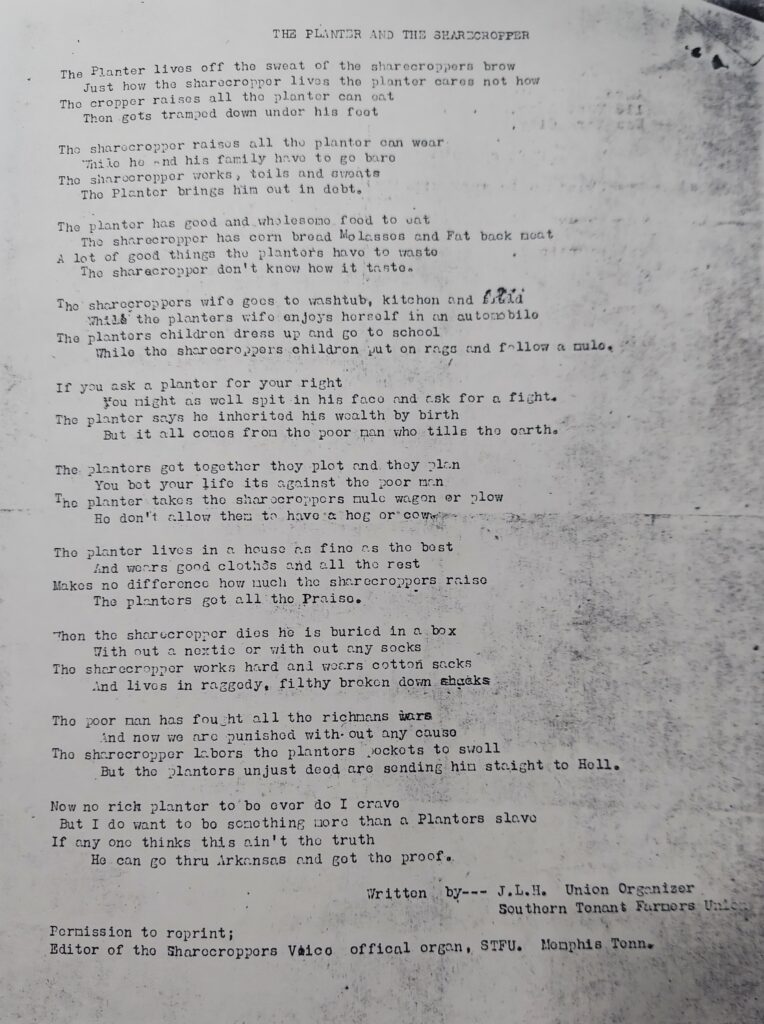
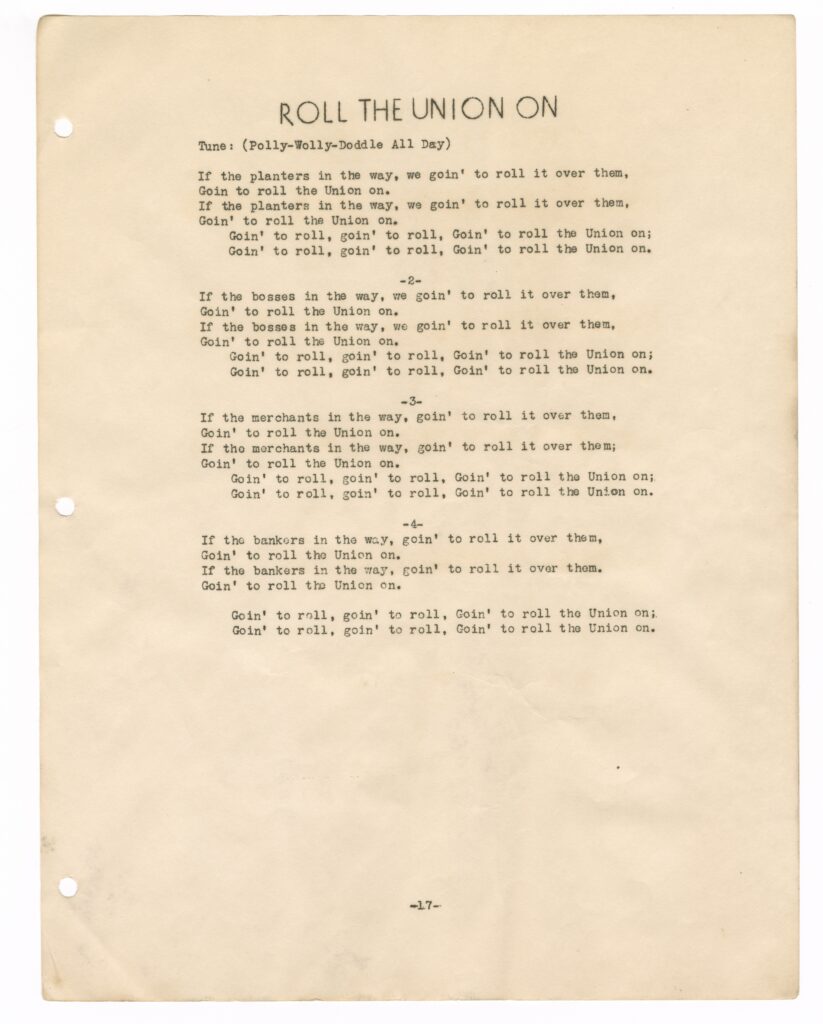
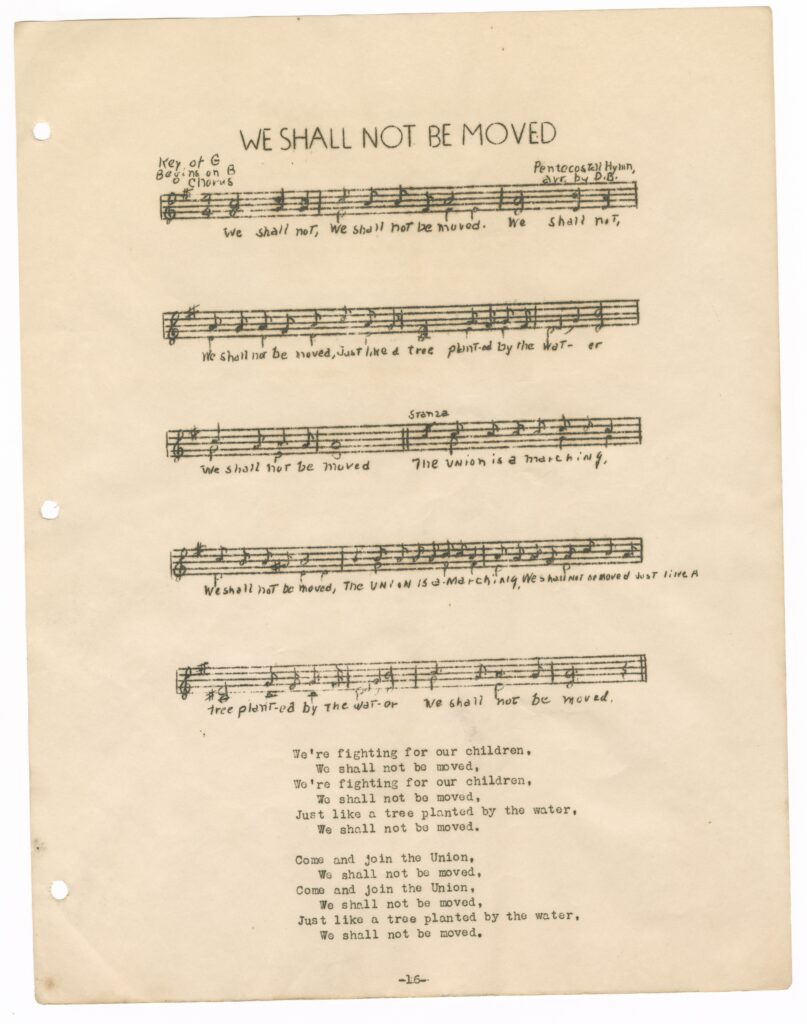
Source: From the Archives: The Southern Tenant Farmers’ Union by Southern Exposure, published October 1, 2021: https://www.facingsouth.org/2021/10/archives-southern-tenant-farmers-union [excerpts].
Procedures
1) Starter
Give an example of resistance or resistance movement in the past or now.
2) Guiding questions
How do citizens/people resist injustice or fight for an important cause in a democracy?
What are different individual and collective forms of resistance?
What results have resistance movements and individual resistance acts produced?
3) Background info.
People have historically resisted injustices and fought for various causes by organizing mass resistance campaigns and through smaller resistance acts. Labor organization and unions are among some of the most common forms of resistance against poor working conditions and mistreatment. As early as 1619, workers in colonial Jamestown refused to work because they were not allowed to vote. In 1794, a group of Philadelphia shoemakers formed the Federal Society of Journeyman Cordwainers, which may be the first labor union in American history. In 1866, the National Labor Union (NLU) was established in Baltimore, Maryland. NLU was the first national union in the United States. One of NLU’s initiatives was to demand an 8-hour work day. In 1869, Uriah Smith Stephens, James L. Wright, and a small group of Philadelphia tailors founded a secret organization known as the Noble Order of the Knights of Labor. After the collapse of NLU in 1873, the Knights of Labor became less secretive and turned into the most influential national labor organization of the 1800s, with nearly one million workers representing various industries and trades. Perhaps the most famous union in American history is the American Federation of Labor (AFL), founded in 1886 by Samuel Gompers. AFL was an alliance of unions representing skilled workers.
In the American history of unions dominated by industrial trades and skilled workers, STFU remains a rare example of organizing tenant farmers.
Other historical examples of citizens’ resistance in US history that may help students think of what form resistance can take:
– Ida Wells’ journalism against lynching (writing as resistance).
– In 1872, Susan B. Anthony voted in a presidential election (exercising the civil rights when you’re denied them).
– Enslaved people sabotaged labor that they were forced to do by working slowly, breaking tools, or faking illness. They also created and performed art (e.g., singing and playing instruments; art is a quintessentially human activity and slavery supporters justified slavery by claiming enslaved people were not fully human).
4) Activities
Analysis of provided primary sources.
Ask students what cause they are passionate about. Following a quick questions and answers session, students create their own expression of resistance in any form, e.g., spoken word/poetry, song, sign, op-ed, infographic, infomercial, presentation, social media post, etc.
5) Rubric
[1 – 5] Exceeding/proficient/novice/emerging/unsatisfactory
Were you engaged and actively participating?
Can you articulate the understanding of key concepts?
Can you accurately identify examples of each concept?
Can you explain different historical or current examples of resistance?
Assessment
Self-assessment:
What did you know? What do you want to know? What did you learn? [KWL]
Exit question (students provide answers on a small piece of paper):
What is a small act of resistance you can implement today?
Reflection
Research examples of state, national, or international organizations that exist today to fight for an important cause.
Research an example of an organization in your state or in the country that fights for the rights of farm workers today.
Extension Relevance
- Find a song that expresses resistance.
- Find modern-day resistance through art (visual, audio, performance, etc.).
- Find a recent news report that shows an example of how workers organize today to fight for better working conditions.
Arkansas Social Studies Standards
| US History | Era 8: 1929-1945, The Great Depression and World War II – United States during and following these major events | H.5.USH.3 H.5.USH.4 |
| Arkansas History, Grades 7/8 | H.1 Students will understand chronology, patterns of continuity, and change over time. This includes the contextualization of historical events and ways people gather, view, construct, and interpret historical evidence. | H.1.ARH.10 H.1.ARH.15 |
| Arkansas History, Grades 9-12 | Era 8: Perspectives of Arkansans in the early 20th century (1929-1940) | H.5.ARH.6 |
| African American History | Era 8: 1929-1945, Seeds of Change – African American experience (1920-1950) | H.5.AAH.1 H.5.AAH.2 H.5.AAH.3 |